

A forecast can be mathematically correct and still be wrong about when the money will arrive.
Imagine an analyst updating next week's cash forecast. The receivables file is current. The model works. But a customer has disputed an invoice, and the only person who knows is the account manager who took the call.
An AI assistant working from that file lacks the same information as a remote analyst receiving it overnight. Neither can reliably incorporate a conversation that never reached the shared record.
This is where the discussion about AI in remote finance teams becomes practical. The habits that make distributed work reliable can also help a business move from individual AI experiments to a process the whole finance function can use. The connection is how context travels with the work.
Why remote teams provide a useful starting point
A well-run distributed team cannot rely on everybody overhearing the same conversation. It needs a place to find the current file, a clear owner for each task, documented assumptions, and a way to hand over unresolved questions.
These practices are useful beyond finance. GitLab's public communication handbook describes an asynchronous starting point and asks people to write down the conclusions of offline conversations. That is an example of how one remote company works, rather than evidence that remote teams automatically perform better. Source: GitLab's communication handbook.
For a finance leader introducing AI, the overlap is worth examining. A defined reporting process gives both a colleague and an approved AI tool a clearer starting point: what the inputs mean, which version is current, what the output is for, and who can accept it.
Remote work alone creates none of this. A team can be distributed and still depend on private messages and one person's memory. An office-based team can have excellent documentation. The useful advantage comes from the operating discipline.
The missing context in a cash forecast
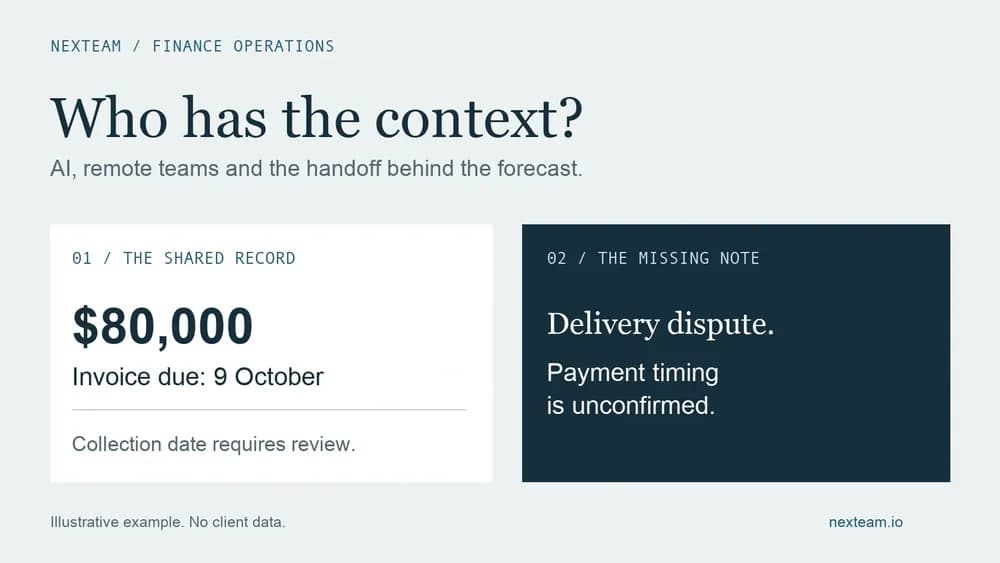
Consider this illustrative example, rather than a client case study. An invoice for $80,000 is due on 9 October. The forecast currently includes the receipt that week. The customer has raised a delivery dispute, but has not confirmed a revised payment date.
The invoice amount and due date remain valid facts. The expected collection date has become an assumption that needs review. Moving the receipt to the following week without evidence would only replace one unsupported assumption with another.
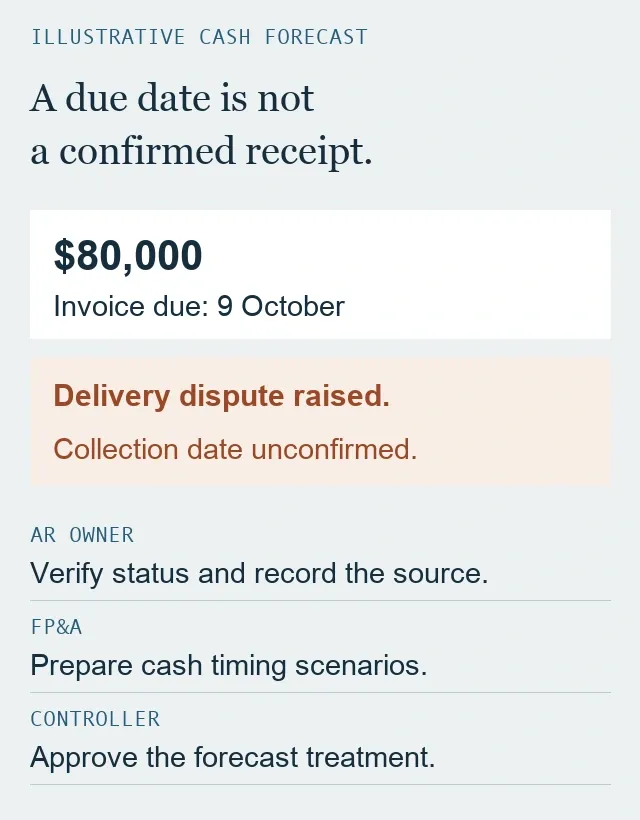
The handoff should point to the relevant collection note and source file, explain what changed, and identify the next action. The AR owner follows up with the customer. FP&A shows the cash effect of the timing uncertainty. The controller reviews the proposed treatment before the forecast is released.
An approved AI tool might help draft a summary or compare versions. Its output remains a draft. A person must check that it preserves the distinction between an invoice due date and a confirmed collection date.
Measure the work after the first draft
Generating commentary faster is useful. Finance leaders also need to know what happens to the work that follows.
If the controller must reconstruct every assumption, trace every explanation, and rewrite the output, the first-draft saving may leave the total workload largely unchanged. There may also be more material waiting for review.
A practical pilot can follow one recurring task across several reporting cycles. Record preparation time, reviewer time, corrections, and unresolved items at release. Keep the scope comparable. A short update and a board reporting pack are different assignments, even if both use AI.
Measure the time to an accepted output, including the work needed to verify it.
For distributed teams, also record where work stops while waiting for context. An unanswered question can hold up a forecast across time zones even when the file itself takes only minutes to update. That waiting time is part of the process worth improving.
Give the reviewer a decision they can actually review
“A human checks it” is too vague to be an operating procedure. The reviewer needs to know what they are checking, what evidence is available, and when to send the work back.
NIST's AI Risk Management Framework discusses the need to distinguish human roles and responsibilities and recognizes that representing decisions in models can remove necessary context. It also notes that human-AI interaction can amplify human biases. Simply assigning a reviewer is therefore insufficient. Source: NIST AI RMF 1.0, Appendix C.
In the cash forecast example, the reviewer should be able to establish:
- What is confirmed: the invoice, amount, contractual due date, and recorded customer dispute.
- What remains uncertain: when the customer will pay and whether further action changes that timing.
- What is proposed: a forecast treatment and the alternative scenario if collection moves.
- Who decides next: the owner who obtains missing evidence and the person authorized to approve the forecast.
Keep those details in the team's agreed record, with dates and links that the right people can access. Use approved systems and appropriate permissions. Capturing useful context does not mean copying every conversation or confidential file into an AI tool.
What this changes about finance hiring
Our view is that better tools can make geographically distributed finance talent easier to integrate, provided the company supplies the context and review structure. That is an operating argument, not a prediction that every role will become more productive or require fewer people.
An experienced professional can recognize that a plausible explanation is unsupported, ask the commercial team a better question, and judge whether an exception changes the decision. Those abilities matter when more drafts and analyses can be produced quickly.
This also changes how to assess candidates. Give an analyst a small, anonymized work sample containing an unresolved assumption. Ask what they would verify before releasing it. For a controller, ask how they would review the output and record the decision. Look for the ability to identify uncertainty and communicate the next step, as well as technical fluency.
Junior development still needs attention. If automation removes some preparation work, managers need other opportunities for junior staff to trace evidence, explain adjustments, and learn from review. Judgment needs practice.
Start with one recurring handoff
Choose a workflow with a clear output and review owner: a cash forecast update, a variance explanation, or an AR exception report. Document the source, cutoff, assumptions, open questions, and approval point. Then test where an approved AI tool helps within that process.
Keep the people doing the work involved. If they need a meeting to resolve an exception, have it, then put the decision back into the shared record. Review what caused rework before expanding the workflow.
The aim is a finance team whose work can be understood, challenged, and continued by someone else. That benefits a colleague in another country, a new hire, and the reviewer using AI to support an analysis.
A shared file gets the work across a time zone. A documented decision makes it usable.
Building your finance team
Nexteam connects companies with finance professionals working within their teams, systems, and review processes. Explore remote financial analysts, remote financial controllers, or the practical split of responsibilities in a hybrid finance team.