


Your controller has given notice, and the next reporting deadline is already on the calendar. The immediate question is who can take responsibility for the next close—and what they need to understand before they do.
A controller handover checklist should connect the work already done, the issues still open, and the people authorised to review the numbers. A folder of spreadsheets is only one part of that transfer.
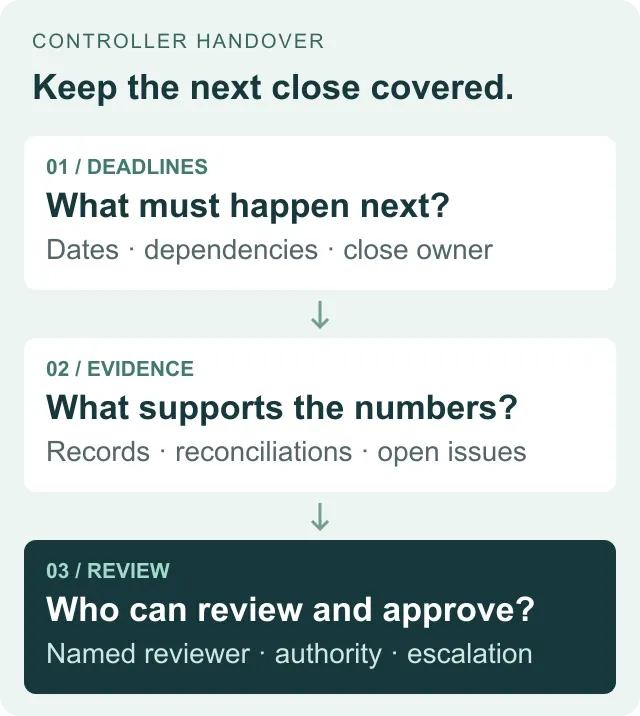
Start here: name the next close owner, the person who will review their work, and the deadlines that fall during the transition. Then build the handover around those commitments.
Start with the next deadline
List the obligations that come due before a replacement can reasonably take over: the management reporting pack, payroll, payment approvals, lender reporting, tax filings and audit requests, where relevant. Record the actual dates from your company's calendar, including dependencies outside finance.
For each obligation, identify a preparer, a reviewer and an escalation contact. If one person currently fills several roles, make that visible. Decide how the review will work while the vacancy is open.
Separate the next close from older cleanup work. An unresolved balance from several periods ago needs an owner and a plan; putting it on the next close checklist does not make it achievable before the reporting deadline.
Six things to include in the controller handover
Use this as an index to the underlying records. For every item, add the file location, the period it covers, the current owner and any unresolved questions. Adapt the scope to your entities and reporting requirements.
| Handover area | What the next owner needs |
|---|---|
| 1. Calendar | Latest close checklist, upcoming dates, dependencies, preparers and reviewers. |
| 2. Balances | Reconciliations, supporting evidence, review status and unresolved differences for the latest closed period. |
| 3. Journals | Recurring schedules, calculations, reversal instructions, accounting policies and decisions awaiting approval. |
| 4. Reporting | Latest issued pack, source reports, mappings, adjustments, definitions, recipients and review comments. |
| 5. Access | Systems, shared folders, access levels, system owners, backup contacts and approval responsibilities. |
| 6. Obligations | Audit requests, filing and lender deadlines, plus unresolved operational issues—with owners and status. |
Ask the incoming owner to open the important files and trace how they were prepared. A link that works for the departing controller may point to a personal drive or a report that only their account can refresh.
Make open issues useful to the next person
“Reconciliation pending” leaves too much to rediscover. A useful exception note identifies the account and period, explains what is known, links the evidence already obtained, and names the next action and decision owner.
Consider this illustrative example, rather than a client case:
Issue: an intercompany balance does not agree between two entities.
Known: both ledger extracts are attached, and the difference has been isolated to two entries. The reason for those entries has not been confirmed.
Next step: the entity accountant obtains the supporting documents. The incoming controller reviews the reconciliation and any proposed adjustment; the designated approver authorises the entry under company policy.
Escalation: if the evidence is still missing at the agreed review point, the controller raises the issue with the finance lead before reporting is finalised.
This gives the next person a starting point without turning an untested explanation into an accepted fact. Keep confirmed findings, assumptions and decisions in separate fields.
ACCA's guide to assessing risks and controls highlights reliance on individual knowledge as a source of risk and stresses the importance of evidence that another reviewer can follow. A transition is a useful moment to test whether that evidence is actually accessible.
Transfer access without transferring passwords
Give the incoming controller their own authorised access to the systems and records required for the assignment. Have the relevant system owners confirm permissions and test access before it is needed for the close.
Keep preparation, review and payment-release authority explicit. A person may need to inspect a bank reconciliation without needing authority to release a payment. Where the team is small, agree and document the alternative review arrangements with the finance lead.
Coordinate the departing employee's access removal with IT and the company's offboarding process. Preserve company records and transfer ownership of recurring reports or workflows through the proper administrators. Do not leave continuity dependent on a shared login or a former employee's account.
Walk through one completed close
Use the latest completed period as a rehearsal. Ask the departing controller to show how a source report becomes a reconciliation, how an exception is resolved or escalated, and how the final numbers reach the reporting pack.
The incoming owner should then be able to explain:
- Where the numbers come from: the system, report, period and filters used.
- What changes before reporting: adjustments, mappings and judgement areas.
- Who checks the result: the reviewer, approval route and evidence of that review.
- What happens when something is missing: the contact, deadline and escalation path.
Capture missing steps while the outgoing controller is available. A recording can supplement the written process if company policy permits it, but the essential instructions and file locations should remain easy to find without replaying a meeting.
If there is no overlap, build a recovery plan
Sometimes the controller has already left. Start by establishing what was last completed and reviewed. Confirm which reports were issued, which balances have usable support, and which recurring tasks are still running.
Bring in the remaining finance team, system owners and relevant advisers to recover context. Mark unverified records clearly. Agree with the finance lead which gaps threaten the next deadline and which belong in a separate remediation plan.
In this situation, the assignment includes reconstructing the process as well as running it. Reflect that in the brief and expected workload. A normal close timetable may need to be reassessed after the initial review; avoid promising that every inherited issue will be resolved in the first cycle.
Decide who will own the next close
The handover often clarifies what kind of support the business needs.
Interim controller: useful when someone needs to take temporary ownership of the close and coordinate review while the permanent role is filled. Agree the scope, authority and eventual handback from the start.
Senior accountant with an identified reviewer: may fit when the gap is mainly preparation—reconciliations, schedules and journals—and an existing finance leader can provide the required oversight. Do not assume preparation capacity also covers an unfilled approval role.
Fractional controller: may fit a continuing need for oversight when the preparation team is established and the review workload can be covered through an agreed recurring schedule.
The distinction is explored further in our fractional vs interim controller guide. Choose the arrangement around the responsibilities and availability required for your close.
Turn the handover into a clear staffing brief
Before speaking with candidates or a staffing partner, prepare a short brief covering:
- The trigger and timing: departure date, available overlap and next reporting deadline.
- The environment: entities, accounting system, reporting tools and working hours.
- The starting position: latest completed close and significant known gaps.
- The assignment: preparation, review, team coordination and reporting responsibilities.
- The authority: who approves journals, releases payments and accepts the reporting pack.
- The handback: documentation and open issues the next permanent owner will receive.
For an interim assignment, plan the handback at the beginning. The work should leave the company with an updated close calendar, reviewable supporting records, a clear exception log and documented responsibilities for the next cycle.
Need controller coverage for an upcoming transition? Explore Nexteam's financial controller support. Share the timing, systems and responsibilities in your brief so the discussion starts with the work that needs an owner.