


The acquisition has closed. Suppliers still need paying, customers need accurate invoices, and the leadership team needs a reliable view of cash. Meanwhile, the CFO is deciding how the acquired business will fit into the group.
Building a finance team after an acquisition starts with those immediate commitments. Map the work already covered, the work without an owner and the decisions that require review. That gives you a practical staffing plan while the longer-term structure takes shape.
AP, AR, accounting, controllership and FP&A are connected workstreams. They do not automatically require five new hires. The right combination depends on the inherited team, the number of entities, the systems and the amount of work needed to resolve exceptions.
Protect the next payment run and close
Begin with the company's actual calendar: supplier payments, billing, payroll coordination, close, management reporting and relevant external deadlines. For each commitment, identify who prepares the work, who reviews it and who can authorise the final action.
Ask the existing team to walk through the latest completed period. Which reconciliations have support? Which customer balances are disputed? Which reports need manual adjustments? Preserve processes that work and record the gaps that could interrupt the next cycle.
This review should produce a short coverage map. A task marked “finance” needs a named owner. A deadline marked “month-end” needs an actual date. An unresolved item needs a next step and someone who can decide what to do with it.
Connect AP and AR to the management numbers
Use the following map to define outputs and handoffs. Several responsibilities may sit with one person, provided the workload and review arrangements make that workable.
| Work | Output / review |
|---|---|
| AP | Invoice queue and payment proposal. Accounting review; authorised payment approval. |
| AR | Billing, cash application and disputes. Updates to commercial, accounting and forecast owners. |
| Accounting | Reconciliations, journals and schedules. Controller or designated reviewer checks the support. |
| Controller | Close plan and reporting pack. Client finance lead reviews escalations and accepts reporting. |
| FP&A | Cash assumptions, variances and scenarios. CFO and operating leaders validate inputs and decide. |
Consider an illustrative cash-planning example. AP identifies an invoice due for payment. AR reports that a customer has disputed an expected receipt. The accountant checks that both items agree with the records, and the forecast owner updates the expected timing. The CFO can then assess the funding implications.
Each person contributes a different piece. If the collections update stays in an inbox, the forecast may still include a receipt that nobody expects to arrive on time. Agree how operational changes reach the forecast owner and when they should trigger a review.
Build the finance team in phases
Start with the responsibilities required to keep the business running. Then use the next completed cycles to learn what the permanent team needs. An acquisition does not make every hiring decision equally urgent.
McKinsey's discussion of post-merger operating models recognises that companies may need an interim arrangement before reaching their intended structure. For finance, this means making the temporary responsibilities clear enough to operate while the final design is still being decided.
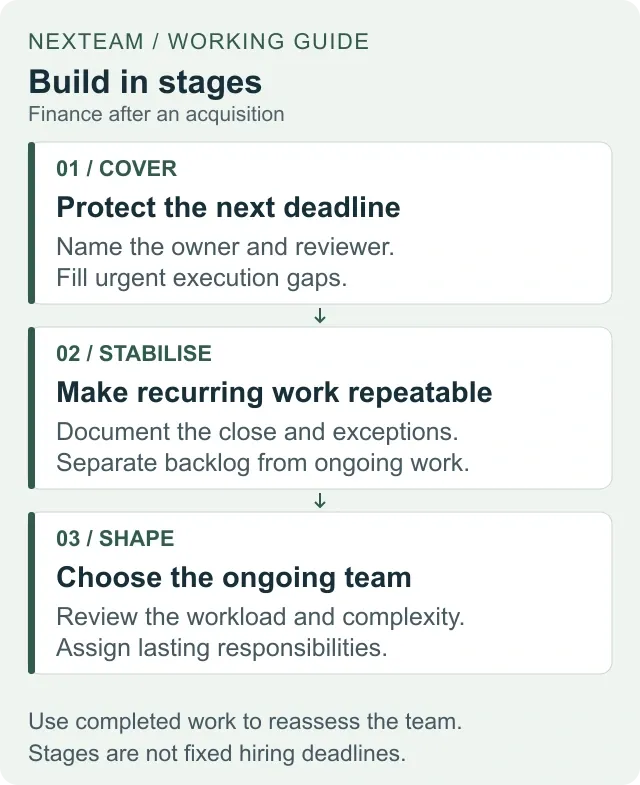
Cover the immediate obligations. Confirm a finance lead and fill the execution gaps that threaten the next payment, billing or reporting cycle. An AP backlog calls for invoice-processing capacity; missing close ownership calls for someone able to coordinate preparation and review.
Stabilise the recurring work. Track completed tasks, unresolved exceptions and time spent recovering missing information. Separate normal monthly work from inherited cleanup. Both require capacity, but a temporary backlog should not silently become the basis for permanent headcount.
Shape the ongoing team. Review the evidence with the finance lead. Decide which responsibilities need a dedicated owner, which can be combined and which need periodic specialist input. For temporary ownership versus continuing oversight, see our fractional and interim controller guide.
Use observable review points, such as a completed close with documented outstanding issues. Avoid promising that every acquired company will reach the same stage within a fixed number of days.
Staff the ERP transition as well as the close
If a system change is planned, list the finance team's implementation work separately. Data preparation, account mapping, reconciliation and user testing require people who understand the records. Those same people may already be responsible for keeping the books current.
In a simple planning example, the senior accountant could prepare opening-balance support, while the controller reviews the proposed mapping and reconciliations. The implementation lead manages the project plan. Someone must still own current-period processing and the next reporting deadline.
Document the expected time for each assignment and what will be deferred or reassigned when project work increases. Hiring a person with experience of the target system helps only if their scope and available capacity match the work.
Make distributed responsibilities visible
A distributed finance team needs an agreed way to pass work between people. Put the following in the assignment brief:
- Ownership: entities, tasks and work products assigned to each person.
- Review: who checks the work, where comments are recorded and what counts as complete.
- Working hours: overlap needed for questions, approvals and time-sensitive issues.
- Access: individual permissions for the records and systems required by the role.
- Continuity: documented procedures and an agreed cover arrangement that has been tested.
Time-zone coverage can inform the design, but geography does not replace a reviewer or an approval route. Our hybrid finance team guide explores how execution and senior oversight can be organised across locations.
Turn the coverage map into a hiring brief
Describe the starting position before listing job titles. Include the next deadline, current team, systems, known backlog and available review capacity. Then specify the first work products and the point at which the assignment will be reassessed.
For example: “Own the invoice queue for the acquired entity, prepare the payment proposal and maintain the unresolved-item log. The group accountant reviews coding; the authorised signatory approves payment. Review the recurring workload after a completed cycle.”
That brief gives candidates something concrete to assess. It also gives the CFO a basis for deciding whether the next addition should be processing capacity, a senior accountant, controller ownership or FP&A support.
Planning finance support after an acquisition? Discuss your team requirements with Nexteam. Nexteam connects clients with talent; the client directs the work and retains the agreed management, review and approval responsibilities.