
Nexteam

Financial Analyst Interview Scorecard for Employers

Use this financial analyst interview scorecard to assess candidates with role-specific questions, a worked finance case, and clear evidence-based ratings.

By Sergio Ermacora
Finance leader reviewing staffing and cost scenarios at a desk.

A useful financial analyst interview scorecard connects questions to the work you are hiring someone to do. For a CFO or hiring manager, the goal is not to find the person who remembers the most definitions. It is to understand whether the analyst can reconcile numbers, explain a forecast, maintain a usable model, and deliver work your team can review.

This guide combines financial analyst interview questions for employers with a short, fictional assessment case and a four-point scoring framework. It is a proposed hiring tool to adapt to your role, not a validated test, a universal pass mark, or a description of Nexteam's internal assessment rubric.

Start with the assignment, not a generic question list

Choose two or three outputs the analyst will actually own: a monthly management pack, a rolling forecast, a pricing model, or a reporting backlog. Specify the source systems, stakeholders, deadlines, review owner, and expected independence.

Use the FP&A job description and role-brief guide if that scope is still unclear. A reporting analyst does not necessarily need an investment-banking modeling test; a junior analyst should not be assessed against a finance manager's responsibilities.

The same principle applies to dedicated, fractional, interim, project-based, and hourly assignments. Change the delivery expectations to match the engagement, not the requirement for accurate and reviewable work.

Six financial analyst interview questions to build around

Ask candidates for their own contribution, the checks they performed, and what happened next. Accept anonymized explanations; do not request confidential employer files. Use the same core questions for the same role, with follow-ups to clarify the evidence.

1. Can they establish which numbers are reliable?

Ask: “Describe a time two reports disagreed. How did you decide what to use before sending an analysis to management?”

Listen for: Checks of definitions, period cutoffs, source ownership, mappings, and reconciliation to a reliable control total. A strong answer distinguishes a confirmed fact from an unresolved estimate.

Probe: “What would you have reported if the difference remained unresolved at the deadline?”

Concern to explore: Choosing the more convenient number without tracing the difference, or removing a discrepancy without documenting it.

2. Can they explain a forecast rather than only update it?

Ask: “Tell me about a forecast you changed after an operating assumption moved. What changed in the model, and what decision did it affect?”

Listen for: A connection between operating drivers and financial results, an owner for the revised assumption, a relevant sensitivity, and a clear explanation of uncertainty.

Probe: “Which part was a calculation, which part was an estimate, and what evidence could change your recommendation?”

Concern to explore: Treating a scenario as a guaranteed outcome or changing a headline forecast without understanding its drivers.

3. Can another person maintain their model?

Ask: “Walk me through a model you handed to someone else. How could they update it and check that it still worked?”

Listen for: Traceable inputs, consistent formulas, labeled units and dates, documented assumptions, useful checks, and a practical handover. Complexity is not a substitute for usability.

Probe: “What happened when you changed a key input or added another reporting period?”

Concern to explore: Unexplained hardcoded values, broken references, or a workbook that only its original author can operate.

4. Can they turn analysis into a management decision?

Ask: “Describe an analysis where the audience needed a decision, not a longer report. How did you present the conclusion?”

Listen for: A concise explanation of what changed, why it matters, the available choices, limitations, and the next decision or action.

Probe: “Give me the version you would send to a busy operating manager in five sentences.”

Concern to explore: Repeating spreadsheet outputs without connecting them to the business question. Assess clarity and usefulness, not accent or presentation polish alone.

5. Can they deliver within a distributed team's workflow?

Ask: “Tell me about a deadline at risk because an input or review was late. What did you do, and what did you leave for the next person?”

Listen for: Clear dependencies, early escalation, an agreed interim deliverable, visible version status, and documented next steps.

Probe: “If you were working part-time, what would need to be agreed before the reporting cycle began?”

Concern to explore: Quietly missing the deadline or assuming that availability outside agreed hours is the solution to every dependency.

6. Can they use AI-assisted work responsibly, when relevant?

Ask: “An approved AI assistant produces plausible variance commentary that you cannot reconcile to the workbook. What would you do before sharing it?”

Listen for: Independent recalculation, source and assumption checks, protection of confidential data, and correction or rejection of unsupported output. The analyst remains responsible for what they submit.

Probe: “Show one calculation you would verify and explain which information you would not put into the tool.”

Concern to explore: Treating fluent output as evidence. Do not score this competency when AI use is outside the role; not having a paid tool subscription is not evidence of poor analytical judgment.

Build your financial analyst interview scorecard

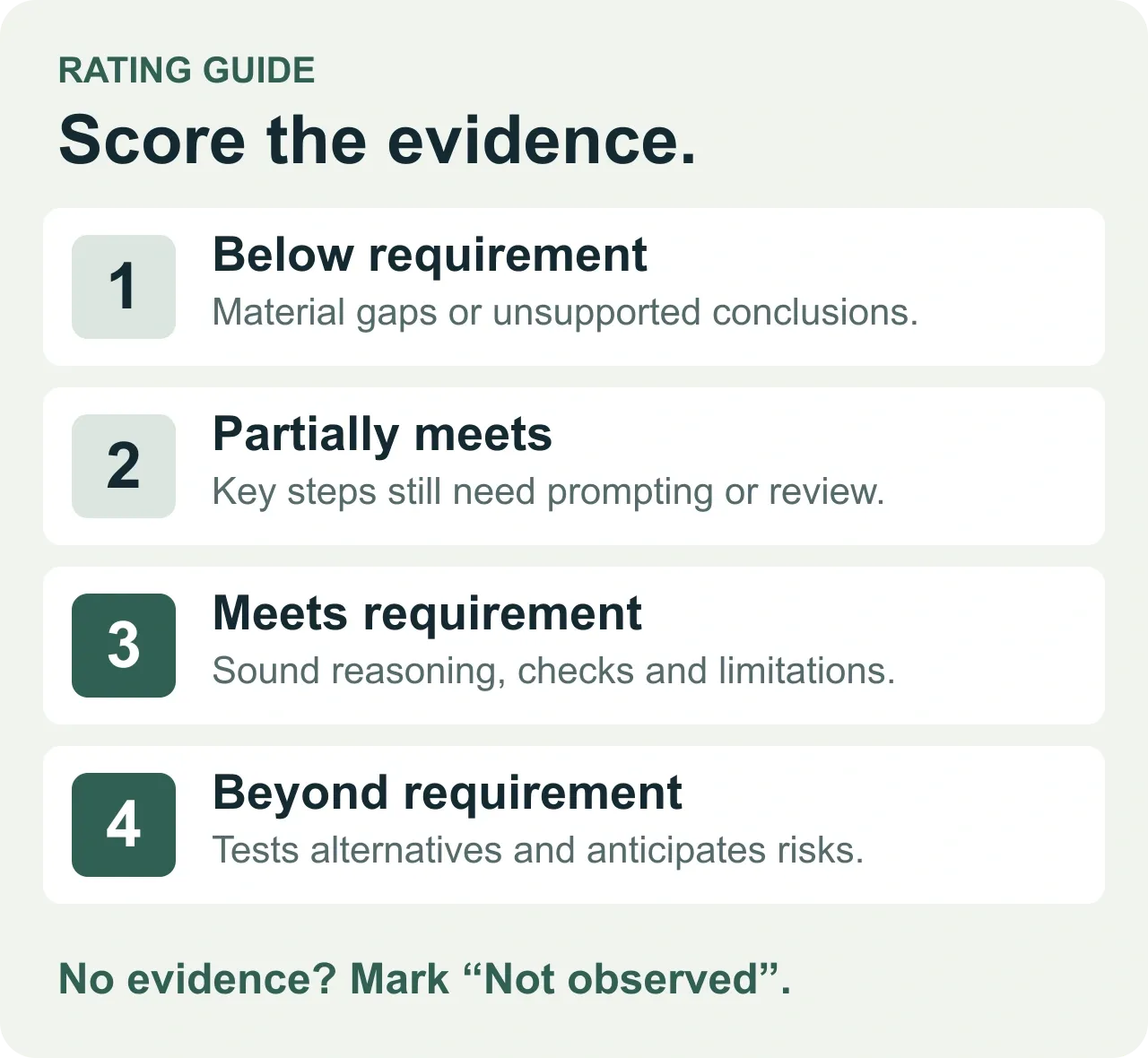
Define the expected standard for the role before the interviews. A structured approach uses consistent questions and rating standards; this follows the general methodology described in the US Office of Personnel Management's structured interview guidance. The scale below is our proposed adaptation, not an OPM-certified instrument.

  • 1 — Below the defined requirement: The example or exercise shows a material gap in a required skill, with insufficient checks or an unsupported conclusion.
  • 2 — Partially meets the requirement: Some relevant evidence is present, but important steps need prompting or substantial reviewer support.
  • 3 — Meets the requirement: The candidate performs the relevant work, explains the reasoning, completes proportionate checks, and identifies limitations at the expected level of independence.
  • 4 — Strong evidence beyond the requirement: The candidate also anticipates a relevant failure mode, tests an alternative, or improves reviewability without adding unnecessary complexity.

Copy this short record for each competency:

  • Role requirement: What must this analyst be able to deliver, and with how much supervision?
  • Rating: 1, 2, 3, 4, Not observed, or Not applicable.
  • Observed evidence: The specific example, calculation, or behavior supporting the rating.
  • Open question: What still needs a follow-up, and who will resolve it?
  • Reviewer and date: Who assessed the evidence and when?

Use Not observed when evidence is missing and Not applicable when the competency is not required. Neither means a score of 1.

Score independently before the debrief. Do not turn the total into an automatic hiring decision or let a polished presentation compensate for an unresolved data-integrity problem. There is no universal pass percentage for this guide.

A practical financial analyst assessment case

Use this fictional single-product business to assess reconciliation, explanation, and model handover. All figures are synthetic monthly amounts in USD, not a client example, compensation data, or a market benchmark.

Give candidates these inputs

Budget

  • Units sold: 1,000
  • Selling price per unit: $120
  • Variable cost per unit: $70
  • Fixed operating costs: $30,000

Actual

  • Units sold: 900
  • Selling price per unit: $125
  • Variable cost per unit: $74
  • Fixed operating costs: $32,000

For this simplified case, operating profit equals revenue minus variable costs minus fixed operating costs. There are no other P&L items. No balance-sheet, payment-timing, or cash-flow data is provided.

Supply this deliberately incorrect draft comment for review: “Sales grew 5% and operating margin reached 24%.” Tell the candidate it is an unverified draft, not a fact to accept.

Request three deliverables

  1. A reviewable workbook: Calculate revenue, costs, operating profit, margin, and budget-to-actual changes. Reconcile the profit movement to explicit drivers.
  2. A five-bullet management note: Correct the draft comment, explain the important changes, identify missing context, and propose the next questions for the business owner.
  3. One scenario and a handover: Increase units by 10% from actual while keeping actual unit price, unit variable cost, and fixed costs unchanged. Label the result as a scenario, document assumptions, and show how someone else can update the workbook.

A suggested starting allocation is 45 minutes for the exercise and 15 minutes for discussion. Pilot it against the role, communicate the format and allowed tools in advance, and adjust the process where needed. It is not a validated speed test or a request for unpaid client work.

Reviewer checks and worked answer

Budget: Revenue is $120,000; variable costs are $70,000; operating profit is $20,000; operating margin is approximately 16.67%.

Actual: Revenue is $112,500; variable costs are $66,600; operating profit is $13,900; operating margin is approximately 12.36%.

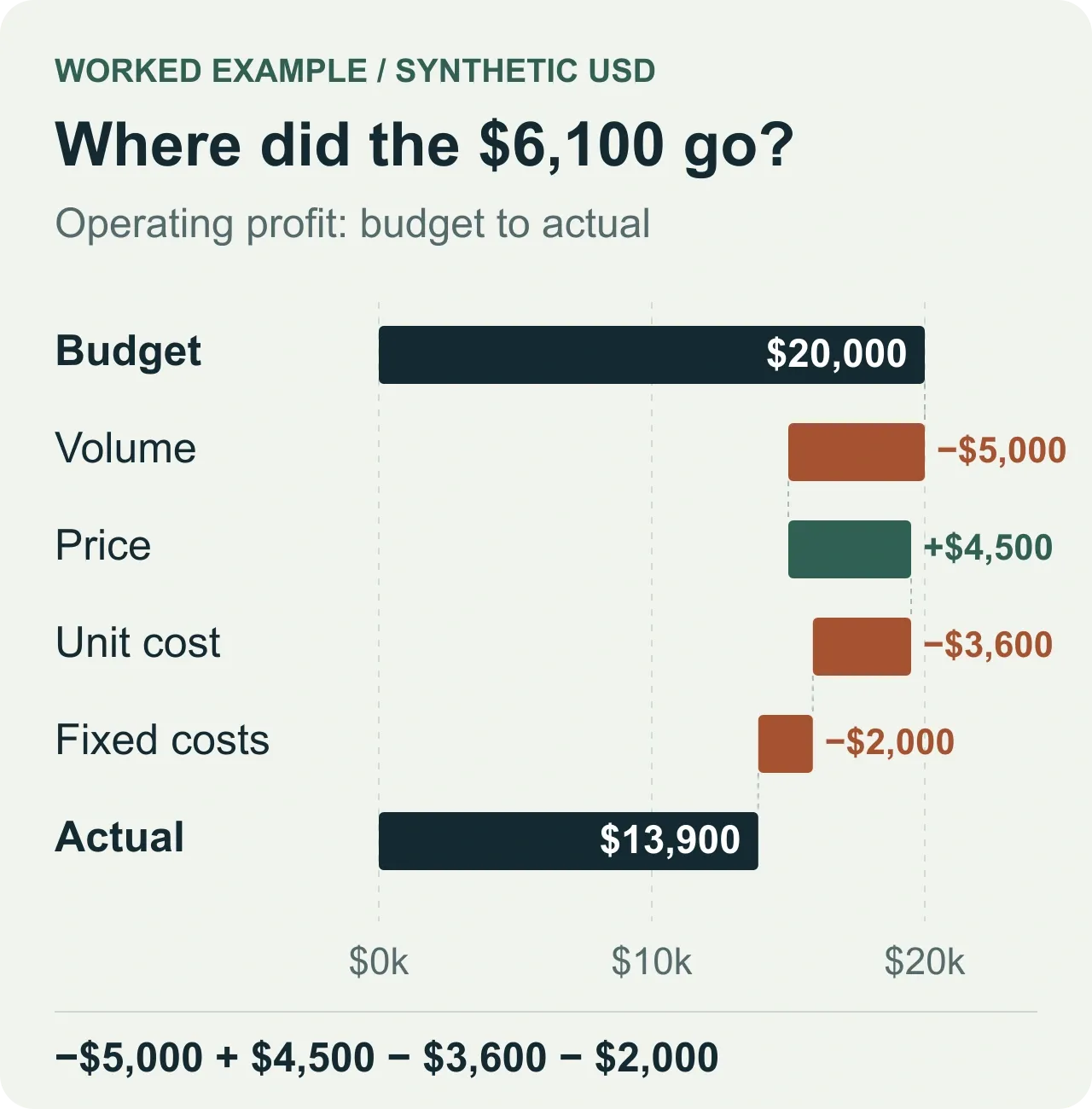
Revenue fell by $7,500, or 6.25%, while operating profit fell by $6,100. One consistent bridge from budget to actual profit is:

  • Volume at budget contribution per unit: −$5,000.
  • Selling-price change applied to actual volume: +$4,500.
  • Variable-cost-per-unit change applied to actual volume: −$3,600.
  • Higher fixed operating costs: −$2,000.

Together, these explain the −$6,100 profit movement. Other decompositions can be valid if the candidate states the method and reconciles it without double counting.

In the scenario, units rise to 990, revenue becomes $123,750, and operating profit becomes $18,490. This is not a prediction that demand will increase, and it does not establish cash generation. A useful discussion asks what evidence would support the volume assumption and whether costs would really remain unchanged.

This answer key is public. Change the inputs for an actual assessment and ask candidates to explain their work live; memorizing these figures is not the skill you are hiring for.

Adapt the interview to the engagement

Dedicated analyst: Emphasize recurring ownership, collaboration with input owners, reporting quality, and improvement over several cycles.

Fractional or hourly analyst: Agree available capacity, recurring meetings, input deadlines, escalation arrangements, and who covers work outside the agreed scope.

Interim analyst: Test the ability to understand an existing process, maintain continuity, document exceptions, and transfer ownership at the end of the assignment.

Project analyst: Focus on acceptance criteria, milestones, model documentation, scope changes, and a usable handover.

Use Nexteam's finance talent engagement models to compare those structures. Consider budget separately using the Finance Talent Cost & Rates guide; a lower price does not resolve a mismatch in responsibilities or supervision.

Questions hiring managers often ask

What should financial analyst interview questions assess?

Prioritize the work: reliable data, driver-based analysis, usable models, decision-focused communication, and delivery ownership. Add industry, systems, transaction, or AI requirements only where the assignment needs them.

How do FP&A analyst interview questions differ from an investment analyst interview?

For an FP&A assignment, use forecasting, operating drivers, management reporting, and business partnering. Transaction or investment roles may require a different case involving valuation or diligence. Do not use this operating example as proof of skills it does not test.

Should candidates be allowed to use AI?

Set the same disclosed tool policy for comparable candidates. If AI is allowed, use synthetic data, require appropriate verification, and ask the candidate to explain the calculations. If it is not allowed, make that clear before the exercise.

What if the interview and assessment disagree?

Identify the specific gap. Ask a focused follow-up or use another relevant example before drawing a conclusion. Record what was demonstrated and what remains unknown; avoid replacing evidence with a general impression of “fit.”

Match the analyst to the work

A scorecard is useful when it helps your team make a clearer decision. Agree the outputs and review responsibilities first, then compare candidates against those requirements.

Share your financial analyst requirements with Nexteam to discuss matched profiles for dedicated, fractional, interim, project-based, or hourly support. For the broader process, see how Nexteam evaluates finance talent.

Grow with Nexteam