
Practical guide
AP and AR: The Missing Inputs in Your Cash Forecast
Turn AP and AR updates into traceable cash assumptions. Separate due dates, expected payments and settled cash, with clear owners and review.

AP AR accounting and cash forecast support
Which part of your cash process needs support?
Describe the gap in collections, payables, reconciliation or forecasting. We will help define the role that should own it.
Your model can be right while its inputs are wrong
Your cash forecast says a customer will pay on Friday. AR knows the invoice is disputed. Your forecast also includes a supplier payment that AP has already moved to next week, with approval.
The spreadsheet may calculate correctly. The information feeding it is already out of date.
AP and AR support a useful cash forecast by explaining when money is expected to move, what supports that expectation and what changed. An aging report is a starting point. Someone still has to turn it into a reviewed cash assumption.
The minimum useful handoff
Amount and reference
Identify the open item, currency and balance being forecast.
Timing and evidence
Record the expected week, supporting information and the date it was checked.
Owner and next action
Name who will resolve the exception and when it will be updated.
Give each date a different job
| Date | What it establishes |
|---|---|
| Contractual due date | When payment is due under the terms. It does not establish when cash will move. |
| Expected cash date | The team's current timing assumption, supported by dated evidence. |
| Actual settlement date | The bank movement. Check its application in the ledger as a separate step. |
For AP, distinguish the proposed payment run, release approval and expected settlement. For AR, distinguish the customer promise from a receipt. Keep a dated explanation for each material change.
Ask AR for the exceptions behind the aging
An AR aging report tells you which invoices are outstanding and how old they are. For forecasting, add the information that changes the expected receipt:
- An invoice or customer reference and the open amount and currency.
- The expected collection date or week, plus the basis for using it.
- The latest relevant customer response and when it was received.
- Disputes, pending credit notes, missing purchase orders or other blockers.
- The person responsible for the next action and the next update date.
Keep a customer payment promise distinct from a receipt. A promise can support a forecast assumption; it does not close the item. Where there is no current customer evidence, document the assumption being used rather than presenting a guessed date as confirmed.
For a large ledger, focus the discussion on items that changed or need a decision, using thresholds agreed by your finance lead. Keep the full underlying list available for reconciliation.
Ask AP for the payment plan and its changes
AP should connect the open-payables list with the payment process. Identify bills scheduled for a run, items awaiting approval, blocked invoices, supplier arrangements and obligations that have not yet reached the ledger.
Record expected settlement timing as well as the planned release date. Where the team proposes moving a payment, show who can approve that decision and whether the supplier terms allow it. Do not quietly improve a forecast by pushing obligations into later weeks.
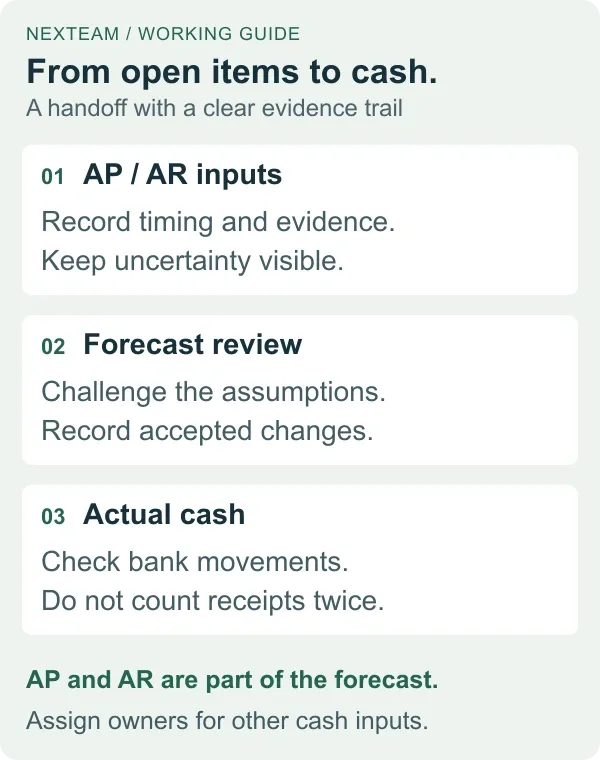
Payroll, taxes, debt service, capital spending and other cash movements may have different owners. Assign those inputs separately. AP and AR are important components of the forecast, not the whole forecast.
Oracle's Cash 360 forecast documentation separately identifies receivables, payables and other cash-flow categories. A tool can combine those inputs; your team still needs to maintain the assumptions behind them.
Follow one change through the forecast
Example: a $12,000 receivable with two different outcomes.
A $12,000 invoice is due this week. The customer confirms an intended $10,000 payment next week and disputes the remaining $2,000. Nothing has arrived in the bank.
AR should preserve the $12,000 open balance and record the two different collection situations. The forecast owner may use $10,000 next week in the base case, clearly labeled as a customer promise, while assigning an explicit treatment to the disputed $2,000. That could be a later assumption or a separate scenario; it should not disappear from the exposure list.
When the receipt settles, the team checks the bank evidence and applies it under the normal accounting process. The forecast replaces the relevant expectation with the actual movement. It must not count both.
The useful discussion is now specific: what changed, how strong is the evidence, and what happens if the promise slips? A single “overdue” label cannot answer those questions.
Build a repeatable input and review cycle
Choose an input cutoff and review time that work with your banking and payment routines. An example sequence is:
- Prepare: AP and AR refresh their source lists and record material changes with evidence dates.
- Review: the designated finance lead challenges timing, duplicate entries and unsupported assumptions.
- Update: the forecast owner records accepted changes and preserves the prior version.
- Compare: reconcile actual cash movements against the prior forecast and explain the differences.
Use the AP/AR Cash Input Review to discuss two important items and capture the decisions before updating the model. It is a handoff sheet, not a replacement for your ledger or full forecast.
If a receipt is late, distinguish a timing shift from a lower expected amount. If a supplier payment disappears, establish whether it was paid, rescheduled, duplicated or omitted. Those explanations lead to different decisions.
Choose the role that owns the missing step
| Recurring gap | Capacity to consider |
|---|---|
| Customer follow-up, disputes and receipt allocation | AR support with an exception list and a clear credit/escalation owner. |
| Bill preparation, approvals and supplier runs | AP support within the client's payment controls. |
| Reliable inputs are available but the forecast is not maintained | An accountant or FP&A/financial analyst with forecast ownership and a named reviewer. |
| Timing assumptions and exceptions stay unresolved | Controller or finance-lead review capacity and decision authority. |
Hiring an analyst to copy unreliable ledgers into a model will carry the same uncertainty forward. Establish the input handoff before expanding the model.
Explore remote accountants, financial analysts and controllers according to the work that is missing. Nexteam recruits professionals who work inside your team; your manager sets priorities and reviews the agreed output.
AP AR accounting and cash forecast support
Which part of your cash process needs support?
Describe the gap in collections, payables, reconciliation or forecasting. We will help define the role that should own it.