

The payment run is waiting. Your controller is chasing an invoice approval, checking a supplier statement and answering another question about a missing purchase order. The close review gets pushed into the evening.
A growing finance team can reach this point without needing a second controller. The next hire should own a defined body of work that is consuming the controller's time. Accounts payable support is one possibility. An accountant, a process change or a clearer approval route may be the better answer.
Start with the decision
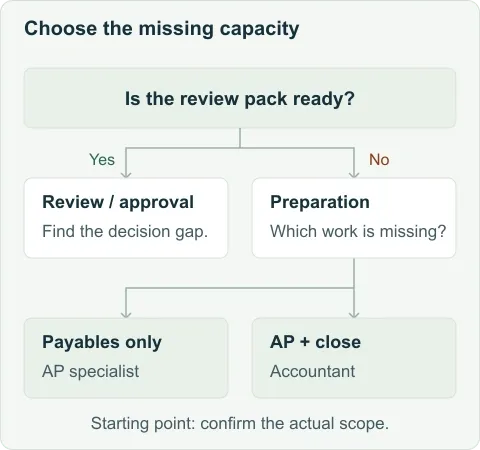
Start with the work that keeps coming back
Review a recent payment cycle and a recent close. For each recurring interruption, record what was missing and what the controller actually did. “Helped with AP” tells you less than “located the invoice, checked the supplier balance and chased approval.”
| What keeps coming back? | Investigate this need |
|---|---|
| Invoices, supplier queries and approval follow-up | An AP specialist with clear ownership of preparation |
| Reconciliations, accruals and wider close schedules | An accountant who can prepare the broader work |
| Complete work waiting for accounting decisions | Protected controller review time or additional senior support |
Use this as a starting point, then check the underlying cause. A queue created by unavailable approvers will not disappear simply because someone else sends the reminders.
Match the role to the actual environment
Match experience to the actual invoice complexity, entities and system. High volume and difficult invoice resolution are different demands.
| Role | Define these outputs and boundaries |
|---|---|
| AP specialist | Invoice preparation, supplier-statement checks, routine queries and a payment proposal. Keep unresolved items in an exception note; approvals follow company controls. |
| Accountant | Reconciliations, accruals, prepayments and the specified close schedules, alongside agreed AP work. Name the reviewer for each output. |
| Controller / senior reviewer | Resolve assigned accounting questions, review preparation and accept or return exceptions. Payment authorization remains with designated approvers. |
Reconciling a supplier statement differs from investigating why an AP control account disagrees with its subledger. If the assignment includes both, test both. See the senior accountant versus controller guide for the broader distinction.
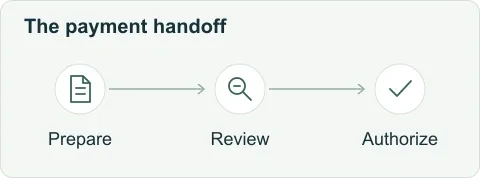
What a useful handoff looks like
Illustrative workflow, not a client result.
The preparer finds a possible duplicate invoice, an unapproved service bill and an emailed request to change bank details. Each needs a different next action.
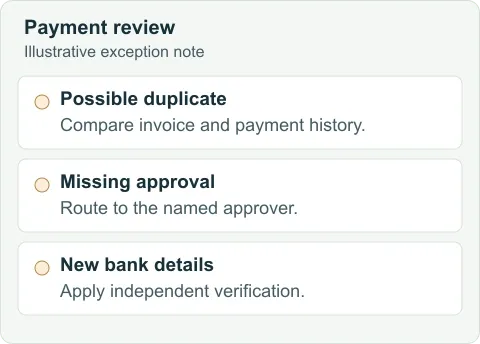
The controller receives evidence and a clear next owner for each exception. The preparer should not delete a valid liability, treat silence as approval or accept emailed bank details without the company's verification process.
Preparation and authority to release funds are separate responsibilities. Oracle's Vendor Bill Approval Workflow documentation shows how software can route bill exceptions for review. Your process still needs named owners and clear permissions.
Before handing over the first payment cycle
Use this setup checklist with the controller and the people supplying information:
| Setup check | Ready when… |
|---|---|
| Invoice intake | The route and required supporting documents are agreed. |
| System access | Permissions match the assignment. |
| Approvals | Approvers and an escalation contact are named. |
| Vendor changes | Maintenance and independent verification responsibilities are clear. |
| Review calendar | Cutoff, pack delivery and review time are agreed. |
A new hire cannot reconstruct undocumented purchasing decisions without help. Give them access to the people who can answer those questions.
Keep the initial scope manageable. If the assignment is AP, list any payroll, collections or forecasting work separately. The finance-team role guide can help allocate the wider responsibilities.
Hand over one complete payment cycle
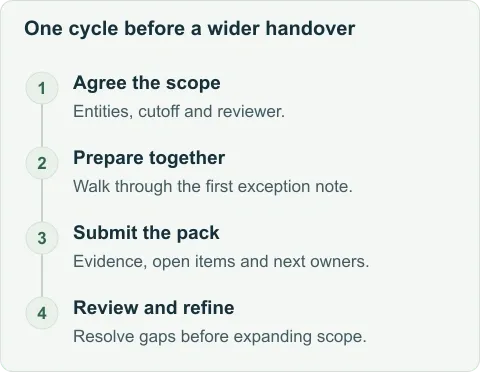
Start with an agreed cycle and review point. Expand the assignment after checking the work and the reviewer's capacity.
Test the handoff, then review its quality
Give candidates a fictional invoice bundle, supplier statement and approval log. Include a duplicate submission and an item lacking approval. Ask for a short exception note for the reviewer.
| Look for | Warning sign |
|---|---|
| Evidence behind the proposed action | A tidy list with no supporting checks |
| Unresolved items kept visible | Missing information silently treated as complete |
| A named owner for the next decision | Every question sent back to “finance” |
Track whether the handoff is improving
| Track | What it helps you identify |
|---|---|
| Pack delivered on time | Whether preparation meets the agreed review cutoff. |
| Rework returned | Missing evidence or checks that need correction. |
| Aging exceptions, by cause | Whether delay sits with preparation, an approver or the supplier. |
Establish a baseline before setting targets. Invoice count alone does not show handoff quality.
| A starting brief |
|---|
| Own invoice preparation, supplier-statement checks and approval follow-up for the agreed entities. Prepare the payment proposal and exception note on schedule. The controller reviews accounting exceptions; authorized approvers retain payment decisions. List broader close work separately. |
Add your system, workload pattern, working-hour overlap and reviewer. Bring three recurring tasks to the conversation and Nexteam can help define the right hire. Your team directs the professional and retains approval authority.