

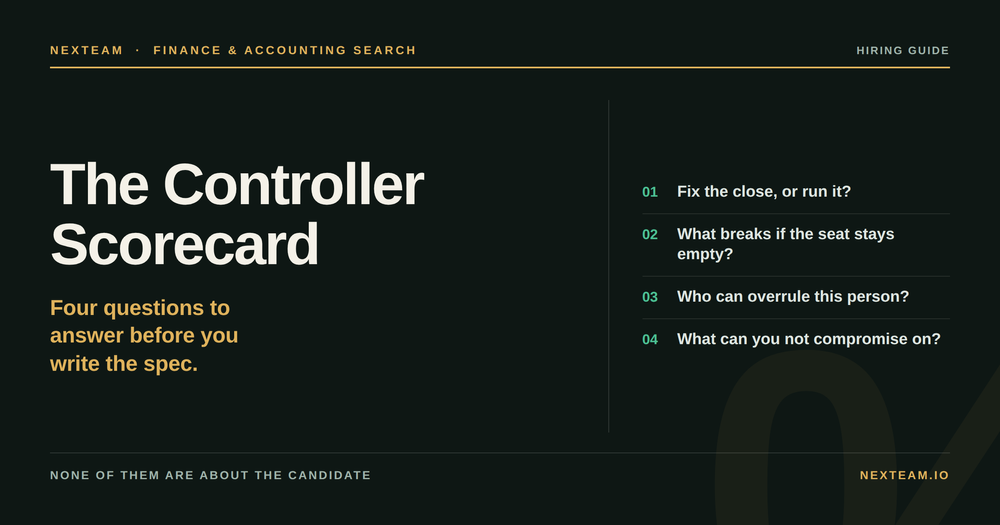
Answer them before a job description exists. None of them are about the candidate. All four are about you. If a question has no answer yet, that is the finding, and it is a great deal cheaper to have it now than in a final interview.
01. Are you hiring someone to fix the close, or to run it?
Two different people. They rarely interview well against each other.
If the answer is fix it. The close is slow, the process is undocumented, or nobody really owns it. Hire for willingness to make people uncomfortable rather than for interview polish. Expect two to three years and then a departure, because people who fix things get offered bigger things to fix, so budget for the succession now rather than being surprised by it. And do not screen out the candidate who challenges you in the interview. That is the trait you are buying.
If the answer is run it. The process works and you need it to keep working. Hire for continuity and institutional knowledge, which does not appear in a handover document. Ambition is a risk here rather than a virtue, so test for it at offer stage. And stop interviewing for a transformation you do not actually want.
Most companies say fix it, then hire whoever was easiest to sit in a room with.
Understanding why mid-level finance talent creates leverage helps define whether the controller should execute, improve, or own the function.
02. What breaks if this seat is still empty in six months?
Name the thing, not the role.
If you can name it. You have a business case, and the spec more or less writes itself from the consequence. Lead the brief with what breaks rather than with a list of duties. Requests written as a consequence get approved. Requests written as an org chart get cut.
If you cannot name it. This is an org chart hire, and it will be the first line cut in the next budget round. Before going any further, find out who is absorbing the work today, because there is always someone. That person can usually describe the role better than the job description can.
03. Who can overrule this person, and on what?
Not the reporting line. The authority.
One name with a clear scope. Fine. Move on.
Two names without an agreed priority. Stop, and fix this before the search rather than during it. If the Controller and the CFO both have a claim on this person's time and have not agreed which one comes first, your strongest candidate will work that out in the final round and read it as a company that is not organized. It is one of the most common reasons a strong candidate withdraws late, and the company almost always concludes that the market was competitive instead.
04. What is the one thing you cannot compromise on?
There is always one.
If you can name it. Everything else becomes a preference rather than a requirement, and the shortlist halves. Three real candidates is a better week than fifteen possible ones.
If everything is essential. Then nothing is, and you will meet fifteen people to find that out. Pick the one.
A strong process must evaluate finance talent for judgment, context, and communication as well as technical competence.
How to use it
Answer the four yourself first.
Then put the same four questions to each interviewer separately, before the final round, and compare what comes back. Question 03 is the one that most often comes back different, and it is the one your candidate will notice.
A blank answer is not a failure of the exercise. It is the exercise. These four questions exist to find the one you have not settled yet, because that is the one your search is going to run into.
Nexteam runs finance and accounting searches. If you are about to open a Controller seat and question 02 or 03 does not have an answer yet, that is usually worth a conversation before the spec gets written.
Once the scorecard is clear, compare fractional and interim financial controller support against the responsibilities you have defined. Use the fractional vs interim controller guide to distinguish recurring part-time ownership from temporary coverage or a transition.
Nexteam's finance talent solutions can help match the role to the right level of ownership and experience.