
Practical guide
CPA Firm Outsourcing: Plan for Review Capacity
More preparers can create a longer review queue. Find where client work stalls, measure the load and hire for the capability your firm is missing.

CPA firm accounting staffing
Hire for the gap in your client-work cycle
Tell us the client work, systems and review responsibilities. We’ll discuss the accounting experience and capacity your firm needs.
Forty prepared files are not forty finished files
A CPA firm adds preparation capacity. More client packs arrive on time, yet the manager’s review queue grows and partners still spend Friday chasing corrections.
The firm may have improved one stage while overloading the next. Before adding outsourced accounting staff, measure where the work waits and how much review effort it creates. That makes the staffing brief more precise: another preparer, a more experienced accountant, dedicated review capacity or a better handoff may each solve a different problem.
Find where the file stops
Before preparation
Client information is missing or access is incomplete. Assign input chasing and escalation; another preparer may simply inherit the same blocked files.
Before or during review
Packs arrive faster than the authorized reviewer can assess them, or they require substantial reconstruction. Separate volume from readiness.
After review
Corrections, client decisions or release approval remain open. Name the person who can close each item and reserve time for re-review.
This guide focuses on recurring client accounting and management-reporting work. CPA.com’s CAS resources describe the broader opportunity to turn financial and operational information into useful client insight. The capacity model here addresses a narrower operational question: can your firm finish the work it accepts?
Audit opinions, tax-return signing and other regulated responsibilities need their own qualified owners and engagement requirements. A staffing label does not transfer that authority.
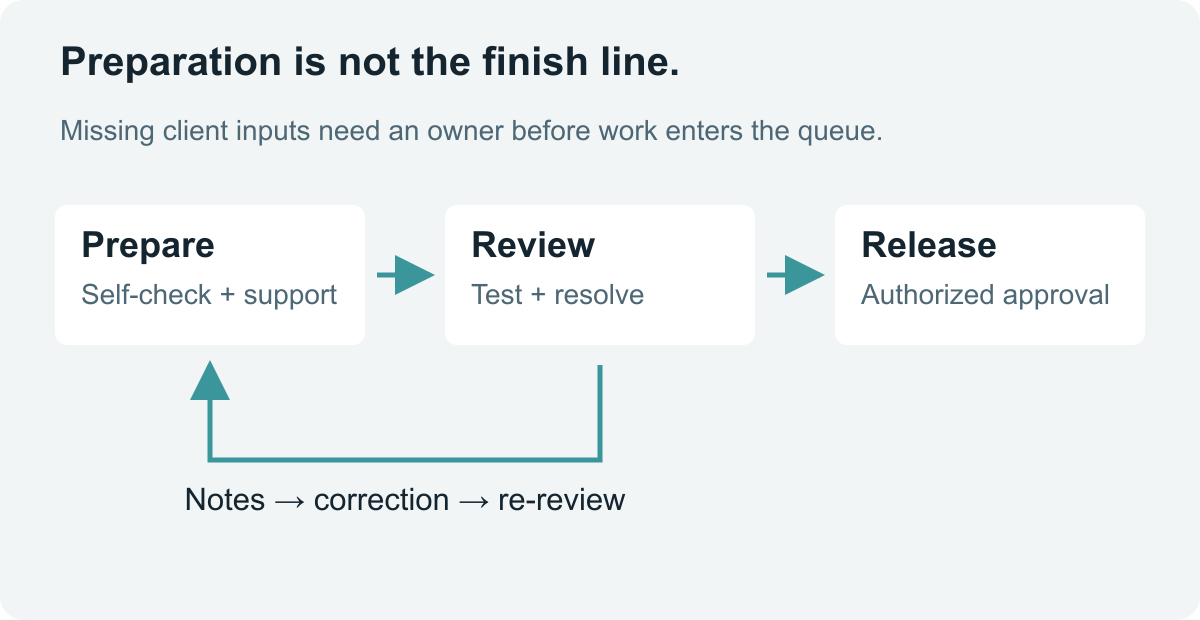
Different bottlenecks need different action
| What you observe | Check first | Possible response |
|---|---|---|
| Prepared files pile up untouched | Net reviewer time and when files arrive | Reserve review windows, stagger arrivals or add suitable reviewer capacity |
| Most review time rebuilds the file | Source support, self-checks and preparation experience | Improve the readiness standard or the preparer’s technical capability |
| Files wait on client answers | Named input owner and escalation timing | Give input coordination a clear owner and earlier deadline |
| The same notes return repeatedly | Whether corrections were understood and checked | Coach the preparer; require a response against each review note |
| Reviewed packs wait for release | Decision authority and partner availability | Agree a release owner, backup and decision window |
Swipe horizontally to see all columns.
Count review hours, not only files
A routine monthly pack and an unfamiliar, multi-entity client do not create the same review workload. Group comparable work and record first-review minutes, the share that returns and the minutes needed to review those corrections.
For each group, estimate:
Review hours = packs × (first-review minutes + return rate × return-review minutes) ÷ 60.
The return rate is the share expected to need one additional review pass. If repeated returns are common, include their expected effort too. Preparer correction time is separate; the formula measures the reviewer’s load.
An illustrative week: 40 packs, 31.4 review hours
| Input | Routine packs | Complex packs |
|---|---|---|
| Packs arriving for review | 30 | 10 |
| First review per pack | 30 minutes | 75 minutes |
| Share needing a return pass | 25% | 40% |
| Re-review per returned pack | 15 minutes | 30 minutes |
| Expected total review load | 16.9 hours | 14.5 hours |
Swipe horizontally to see all columns.
Together, these packs need 31.375 review hours, rounded to 31.4. If your reviewer has 26 hours available after other commitments, new work exceeds capacity by about 5.4 hours. Start the week with six hours of backlog and the expected ending backlog is about 11.4 hours, assuming all 26 hours can be applied to this work.
Adding preparation capacity for another 20 routine packs creates 11.25 additional review hours under the same assumptions. Total new demand reaches 42.625 hours. Preparation throughput has increased, while the downstream constraint has become more severe.
These are example inputs, not industry benchmarks or service targets. Replace them with observed effort across representative weeks. A weekly total also hides timing: work arriving Friday afternoon cannot necessarily use capacity that was free on Monday.
Take the worksheet into your next discussion
CPA review capacity planner
Group your client work by complexity. Enter first-review time, return rates, available hours and opening backlog to see whether the queue is likely to grow.
Agree what “ready for review” means
The file ties to agreed sources
Identify the ledger version, reconcile schedules and make supporting evidence easy to follow. Explain differences instead of leaving the reviewer to find them.
The preparer has completed the self-check
Check formulas, cross-references, consistency with prior periods and completion against the agreed scope. Identify judgment calls separately.
Exceptions have an owner
State the issue, evidence, work already done, remaining question and decision deadline. An unresolved item can be transparent without being silently treated as complete.
Corrections respond to the actual review notes
Keep the note, response and changed location together. The reviewer should be able to check the correction without repeating the original investigation.
A senior accountant is one option—not an automatic answer
If the reviewer is rebuilding technically weak preparation, a more experienced accountant may reduce that burden. If the packs are strong and the reviewer simply has too many to assess, preparation seniority alone will not create additional authorized review hours.
Consider standardizing a recurring schedule, changing arrival dates, reserving review capacity or allocating simpler work to a suitably experienced reviewer. Where a hire is needed, describe the work and authority precisely. “Senior” in the title does not establish readiness to review every client or sign off your firm’s work.
For seasonal planning, use the busy-season staffing guide. For an ongoing capacity problem, build the staffing plan around the review queue and the client mix throughout the year.
Turn the bottleneck into a hiring brief
| Missing capability | What to put in the brief |
|---|---|
| Reliable preparation | Client types, systems, schedules, self-checks, scope and the named reviewer |
| Complex preparation and coordination | Investigation depth, close ownership, judgment boundaries and responsibility for clearing notes |
| Review capacity | Types of work to review, required experience, acceptance standard, reserved hours and escalation rights |
| Client input coordination | Contact permissions, information deadlines, follow-up process and ownership of unresolved requests |
Swipe horizontally to see all columns.
Test one complete client cycle before expanding
Choose a representative client group, agree the readiness standard and reserve the reviewer’s time. Track time to first review, returned items, re-review effort and age of the open queue. Record why a file was returned so missing client information does not get confused with a technical error.
Keep a weekly one-to-one between the professional and manager, with an agenda from both sides, and include the person in the relevant team or client-work meeting. Bring recurring issues into those discussions. The goal is a complete, understood workstream—not a growing pile of submitted files.
Expand only when the handoff works with your client mix and available review capacity. The task-to-workstream guide provides a practical progression.
Where Nexteam fits in your firm
Nexteam can help you find accounting staff for your CPA firm to work inside your processes under your firm’s direction. Define whether the gap calls for a staff accountant, a senior accountant or another level of experience.
Bring the type of client work, systems, expected volume, review boundary, peak periods and working schedule. Your firm retains the management and approval responsibilities agreed for the role. If you want a provider-managed service instead, scope its delivery and review obligations explicitly.
Questions about CPA firm outsourcing
Does outsourcing preparation remove the need for internal review?
No. Agree the review and release responsibilities for the actual engagement. An embedded accountant works under your firm’s direction; additional experience does not automatically transfer approval or signing authority.
Can nearshore staff help with review delays?
Useful working-hour overlap can make questions and corrections easier to resolve. It will not fix missing review capacity, weak preparation or unclear authority by itself. Verify the person’s relevant experience and actual schedule.
What if we do not track review time today?
Start with a representative sample of complete work cycles. Separate first review, re-review and waiting for inputs. Use that evidence to estimate the next week, then revise the assumptions as more work is completed.
CPA firm accounting staffing
Hire for the gap in your client-work cycle
Tell us the client work, systems and review responsibilities. We’ll discuss the accounting experience and capacity your firm needs.