

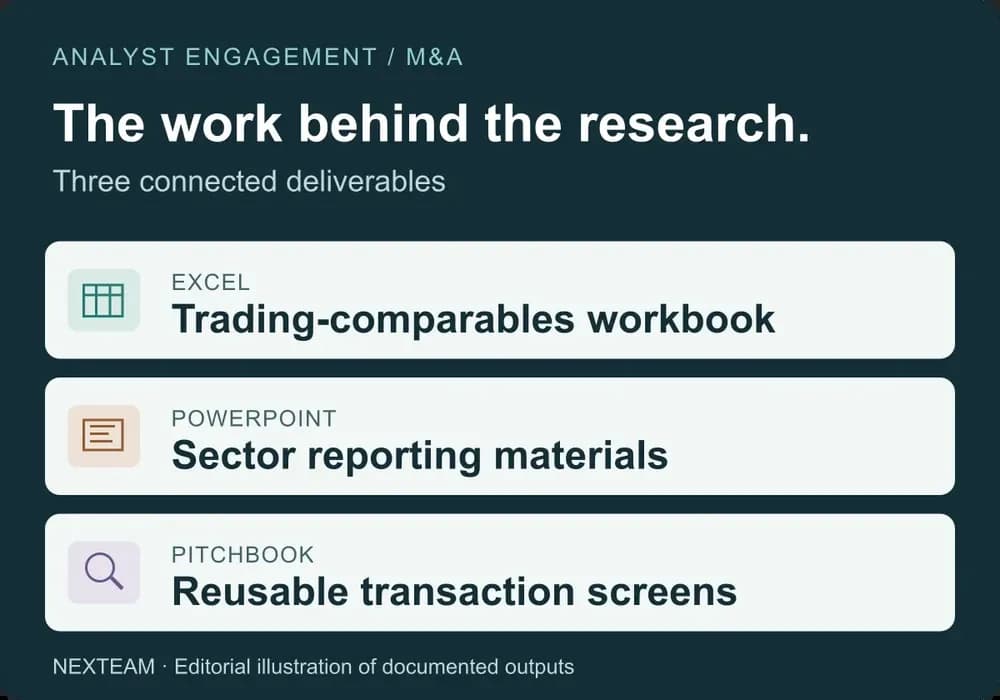
An M&A analyst supporting a boutique advisory team through Nexteam worked across public-company valuation, sector reporting, and transaction screening. The assignment required more than extracting records: the analyst had to check the data, test which businesses belonged in each sector, and turn that work into materials the advisory team could review.
This anonymized case study follows one month of that engagement, from assembling the research base to refining searches the team could use again.
The assignment at a glance
| Workstream | Deliverable |
|---|---|
| Public-company analysis | Excel trading-comparables workbook |
| Sector reporting | PowerPoint market and valuation materials |
| M&A research | Transaction screens saved for recurring use |
The analyst worked in PitchBook, Excel, and PowerPoint. The scope evolved through managing-director feedback, internal review, and progress updates.
First, make the public-company data usable
The analyst assembled a public-company database using the PitchBook Excel add-in, including company identifiers, share prices, market capitalization, enterprise value, revenue, and EBITDA.
Before those inputs could support a sector report, the analyst checked formulas and valuation multiples, worked through historical and last-twelve-month data, and investigated missing consensus estimates and non-meaningful or outlier metrics.
The next layer was market performance: equal-weight sector indices, historical quarterly prices, and comparison with the S&P 500. Newly listed companies and missing price observations required additional handling. These were practical data decisions that a database export alone would not resolve.
A concrete review point: How should a recently listed company appear in a historical performance series when earlier prices do not exist? Handling that gap was part of preparing the sector analysis.
The recorded outputs included sector-level market-performance analysis, median EV/Revenue and EV/EBITDA multiples, and updates to both the Excel model and PowerPoint report.
Then, turn a broad transaction search into a relevant screen
The transaction work began with M&A data organization, a comps master workbook, and selected transactions with company summaries and strategic rationale for the report.
The analyst then developed screens for individual industrial subsectors. These included automation and robotics, electrical products and grid technologies, testing and measurement, construction, industrial services, and flow control.
The process combined keyword and Boolean search criteria with a review of target-company descriptions. Public-company benchmarks helped test whether the search results matched the intended sector. Transactions were classified by high, medium, or low relevance as the criteria were refined.
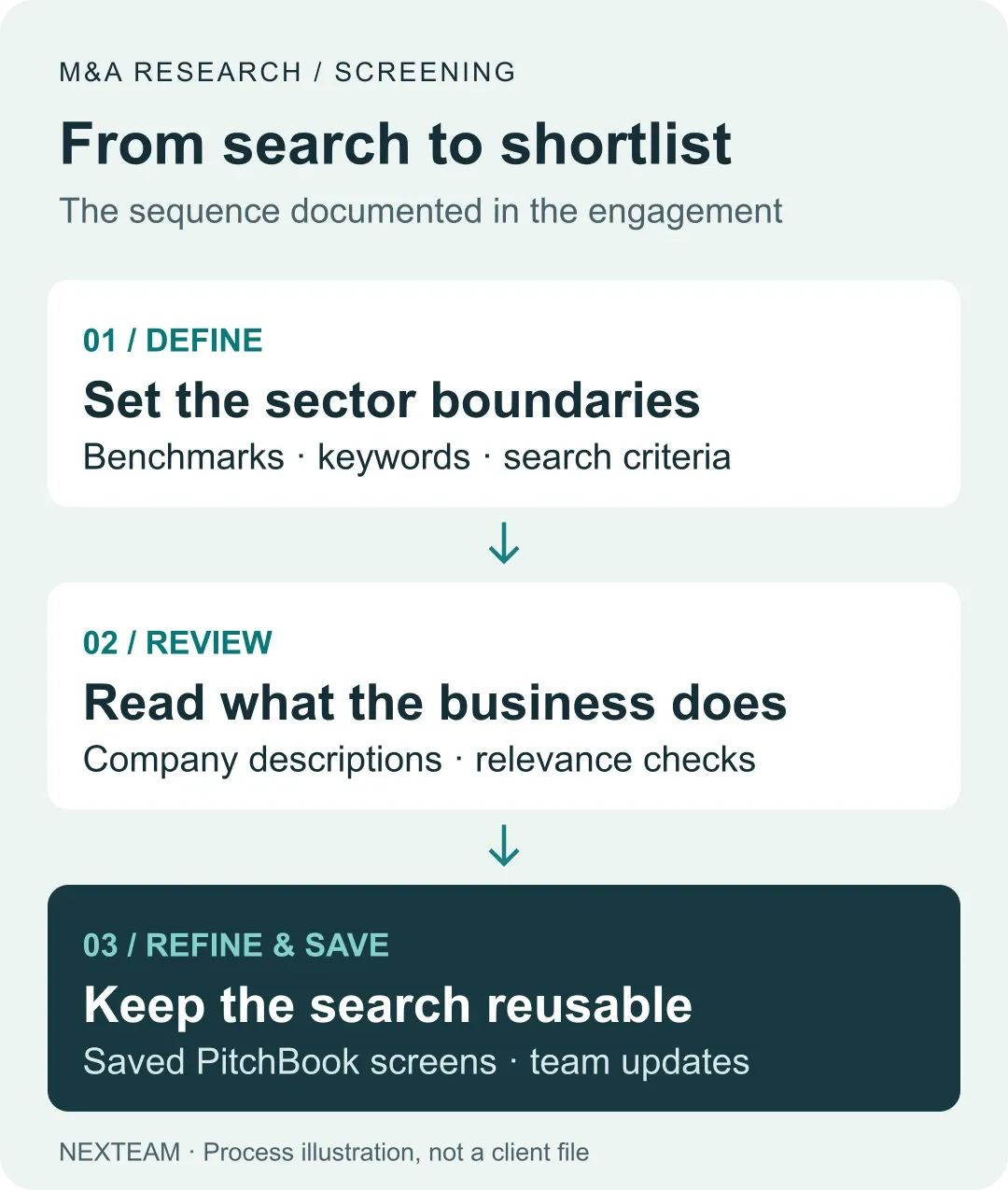
Process illustration based on the work log. It contains no client files or transaction data.
This is where analyst judgment mattered: finding a matching term was only the start. The work required deciding whether the business actually belonged in the research set and refining the search accordingly.
Review was part of the work
Managing-director feedback informed the sector taxonomy and presentation revisions. The log also records a weekly review and a walkthrough of the M&A screening methodology, followed by further refinement and team progress updates.
That review process gave the analyst a way to resolve questions about scope and classification while the work was underway. It also kept draft research connected to the advisory team’s expectations for the report.
What the engagement produced
The documented outputs were tangible:
- An Excel research base: public-company metrics, valuation multiples, and market-performance analysis.
- PowerPoint reporting materials: sector analysis and selected M&A transactions prepared for review.
- Reusable PitchBook searches: completed screening criteria saved for recurring use across several industrial subsectors.
- A record of iteration: methodology discussion, classification refinement, and progress updates to the team.
Saving the screening criteria gave the team a defined starting point for the next research update, alongside the workbook and presentation materials already prepared for review.
What to look for in an analyst for this work
A relevant work sample should show how the analyst handles incomplete data, explains screening choices, and incorporates review comments. Tool familiarity matters, but the useful evidence is in the decisions made around the data.
For a similar assignment, define the sector coverage, source systems, expected workbook and presentation outputs, and the person who will review them. Those details make the scope easier to assess and the first deliverable easier to evaluate.
Building capacity for sector research, comps, or transaction support? Explore Nexteam’s investment banking analysts. For a private-equity team, our analyst delegation guide explains how to define the work and review responsibilities.
Based on the analyst’s engagement work log. Client identity and private transaction details have been omitted.