
Practical guide
Offshore Accountant Cost: What You Actually Pay
Compare the quote, the onboarding and the hours your controller still contributes—with a worked example and an editable cost worksheet.

Accounting hiring
Build a budget for the accountant you actually need
Tell us the responsibilities, systems and working hours. We’ll discuss the role and the information needed for a relevant proposal.
Start with the invoice—and the work it leaves with you
Two accountants can have the same title and leave your controller with very different workloads. One prepares reconciliations, investigates differences and brings a short list of decisions. The other sends a file that still needs rebuilding.
The useful question is what it costs to get the agreed work ready for review, including the time your team contributes. For an offshore or nearshore accountant, compare the provider charge, separate expenses, onboarding and internal review over the same period. Keep cash spending separate from the value of existing employees’ time.
Three numbers to put in the budget
Recurring cash cost
The monthly client charge plus tools and fees that are genuinely additional. This is the amount you expect to pay out.
Internal capacity required
Management, review and correction hours. Value them separately so the proposal shows what your controller still needs to contribute.
First-cycle cost
One-time external setup and internal onboarding. A steady-state monthly quote will not capture the work of getting started.
How much does an offshore accountant cost?
There is no single rate that prices a staff accountant, an experienced close owner and a controller. Start with responsibility and capacity, then request a quote for that brief.
Nexteam’s planning range for accounting support is $18–$50 per hour or $2,000–$5,000 per month, in USD. The proposal depends on responsibility, seniority, agreed capacity and included services. These are client budget ranges, not candidate salaries. Confirm the working hours included in a monthly engagement. The finance talent cost guide explains what to include when comparing proposals.
The worked example below uses deliberately chosen inputs to show the calculation. Replace them with actual comparable proposals; it does not estimate what any particular candidate or country costs.
Get the same job priced before comparing the quotes
| Lock down | Include in both proposals |
|---|---|
| Work and ownership | Accounts, entities, recurring deadlines, investigation and responsibility for clearing review notes. |
| Capacity and schedule | Agreed monthly hours, busy-period coverage, meeting time and actual working-hour overlap. |
| Technical fit | Accounting framework, ERP, industry and the experience needed for the assigned work. |
| Commercial scope | Complete client fee, separate charges, currency, extra hours, notice and transition arrangements. |
| Review boundary | What arrives ready for review, who corrects it and which decisions stay with your team. |
Swipe horizontally to see all columns.
A country salary estimate is not a staffing invoice. Likewise, 100 hours of preparation is not equivalent to 100 hours of senior review. A proposal that cannot describe its scope remains incomplete, even if its price is clear.
For North American buyers, nearshore often means hiring in a nearby region with useful working-hour overlap. Offshore is a broader geographic label. Neither tells you who manages the work. Settle the delivery model separately.
Worked example: a $600 fee difference can disappear
| Monthly input or result | Quote A | Quote B |
|---|---|---|
| Agreed capacity for comparable scope | 100 hours | 100 hours |
| Provider fee | $3,200 | $3,800 |
| Additional tools | $100 | $100 |
| Internal review and coordination | 12 hours | 6 hours |
| Additional internal corrections | 4 hours | 2 hours |
| Internal hourly value | $75 | $75 |
| Monthly external cash cost | $3,300 | $3,900 |
| Monthly internal time value | $1,200 | $600 |
| Monthly economic cost | $4,500 | $4,500 |
Swipe horizontally to see all columns.
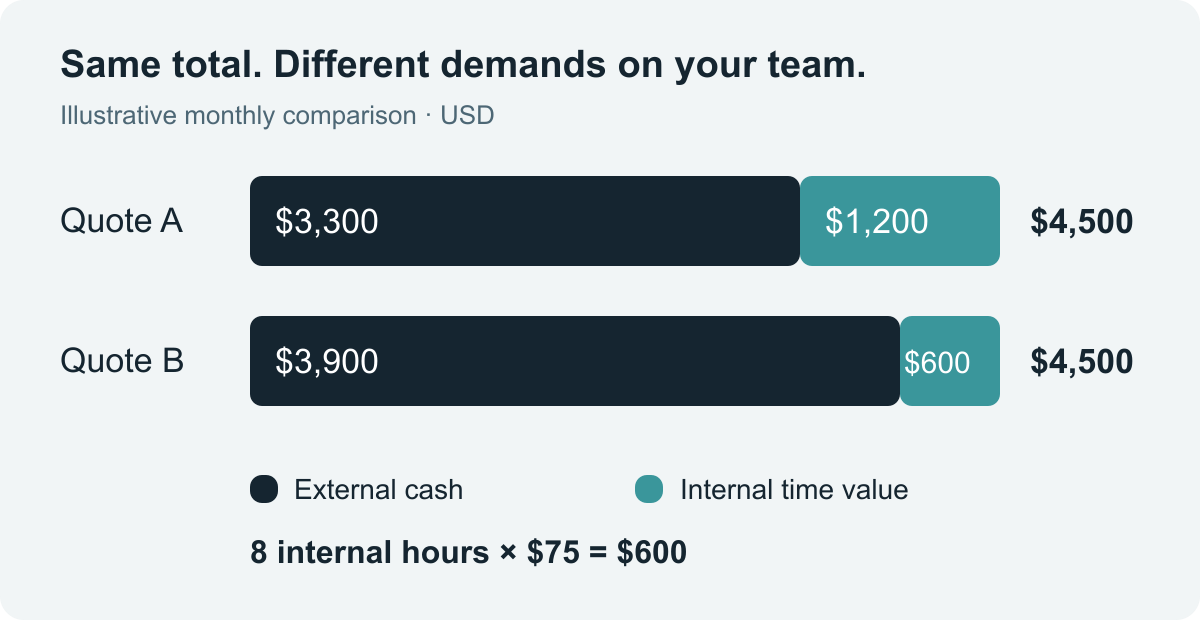
At $75 per internal hour, the $600 fee difference equals eight hours of your team’s time. That is the break-even question to test—not a reason to assume the more expensive proposal will perform better. Ask for work evidence and measure review effort during the first complete cycle.
If the higher-fee option still needs 16 internal hours, its economic cost becomes $5,100. If both require only eight hours, the lower-fee option becomes $3,900. The outcome depends on actual work, not price as a proxy for quality.
Existing salaries do not disappear when review takes less time. Those eight hours may create capacity for another priority; call them a cash saving only when spending actually changes.
Separate startup spending from the recurring month
| Example cost | Each proposal |
|---|---|
| One-time external setup | $600 |
| Internal onboarding | 8 hours × $75 = $600 |
| First-month economic cost | $4,500 + $600 + $600 = $5,700 |
| Three-month economic cost | 3 × $4,500 + $600 + $600 = $14,700 |
Swipe horizontally to see all columns.
The three-month total is equal in this example, but the cash required differs: $10,500 for A and $12,300 for B. The remainder is internal time value. If setup fees, taxes or exit costs differ, enter them rather than assuming they cancel out.
For hourly proposals, multiply the rate by the agreed hours before adding extras. For a fixed project, compare its scope and review rounds with another fixed project. Do not convert either into a “full-time equivalent” unless the working arrangement supports that comparison.
Take the worksheet into your next discussion
Accountant cost comparison
Compare two proposals across recurring cash, internal time and startup cost. Change the blue inputs; totals recalculate. Blank required inputs are flagged rather than treated as free.
Five questions that catch an incomplete quote
What is already included?
Count recruiting, administration, equipment or licenses only once. Ask for the proposal’s actual inclusions, not the provider’s broad website description.
What happens during close?
Confirm capacity on the days it is needed, the treatment of additional hours and who handles competing deadlines.
Who resolves review notes?
Distinguish the accountant’s correction time from the controller’s re-review. A tidy handoff should not transfer unfinished preparation to your team.
What changes after onboarding?
Record the expected steady-state scope and the evidence you will use to judge progress. Do not promise a fixed ramp-up period before seeing the work.
What does changing the arrangement cost?
Ask about notice, replacement, transition, data access and handover. Include any known charge in the comparison period.
Choose the responsibility before choosing the region
A staff accountant may fit defined preparation under an established reviewer. A senior accountant may fit investigation, close coordination and ownership of more complex schedules. If the missing work is accounting judgment, control or final review, assess a controller role instead.
For an embedded Nexteam professional, your manager sets priorities and provides business context. The person works inside your systems and review process. Relevant experience, communication, available hours and working terms still need to be confirmed for the individual.
If overlap with a North American team matters, explore accountants in Latin America. Bring the same scope and cost questions to that search. Geography should narrow a suitable talent pool, not replace the assessment.
Questions buyers ask about cost
Is offshore accounting always cheaper?
The invoice may be lower than an alternative, but total cost depends on comparable scope, capacity, setup and the work your team retains. Compare actual proposals; national salary gaps alone do not establish your saving.
Should I compare candidate salary with a monthly provider fee?
No. Salary and a provider invoice cover different things. For direct employment, build the complete employer cost. For a provider, identify the client charge and any additional expenses. Keep both on the same period and scope.
How can I check the review-time assumption?
Track regular review, coordination and additional correction time over a full work cycle. Record the reason for rework as well as the hours. Separate missing client inputs, unclear instructions and technical mistakes before deciding what needs to change.
Accounting hiring
Build a budget for the accountant you actually need
Tell us the responsibilities, systems and working hours. We’ll discuss the role and the information needed for a relevant proposal.