


During a transaction, documents arrive through different channels and at different stages. One file is missing a schedule. Another has been replaced by a revised version. A signed copy is available, but nobody has recorded whether counsel has checked it.
Paralegal support for transactions can help the legal team maintain an organised record of that work. The assignment should define what the person prepares or coordinates, who supervises them and which decisions remain with counsel.
A useful document tracker makes the next action visible. It distinguishes receipt, review and approval instead of treating every uploaded file as a completed request.
Define the work before choosing the title
Start with the tasks the legal team needs covered. File naming, meeting coordination and routine document collection may fit a legal assistant or transaction coordinator. Delegated substantive legal work may call for a paralegal with appropriate training and relevant experience.
The American Bar Association's guidance on working with paralegals describes paralegals working under lawyer supervision, with the lawyer retaining responsibility. It distinguishes delegated legal work from clerical tasks and identifies limits, including giving legal advice. The supervising lawyer should confirm the permitted scope under the rules applicable to the matter.
That assessment should shape the brief. A job title alone does not establish someone's authority to interpret an agreement, advise a client or approve a transaction document.
Give each workstream a reviewer
Use this as a starting point for discussing the assignment with supervising counsel. The precise tasks and access arrangements need to fit the transaction and applicable practice rules.
| Work | Support / counsel review |
|---|---|
| Inventory | Record files, versions and gaps. Counsel decides whether the request is satisfied. |
| Requests | Follow up with authorised contacts. Counsel confirms requirements and legal deadlines. |
| Drafting | Prepare authorised drafts within scope. Counsel reviews content and legal effect. |
| Signatures | Coordinate approved files and responses. Counsel confirms execution and release instructions. |
| Records | Assemble and index final files. Counsel checks completeness and unresolved legal items. |
For example, identifying that a document lacks an attachment is a useful coordination task. Deciding whether that omission affects contractual rights is a legal question for counsel. The tracker should route the issue to the right person without making that decision on their behalf.
Use status labels that describe what happened
“Done” is difficult to interpret across a legal team. A practical workflow can use three distinct stages, with named reviewers and evidence of each change.
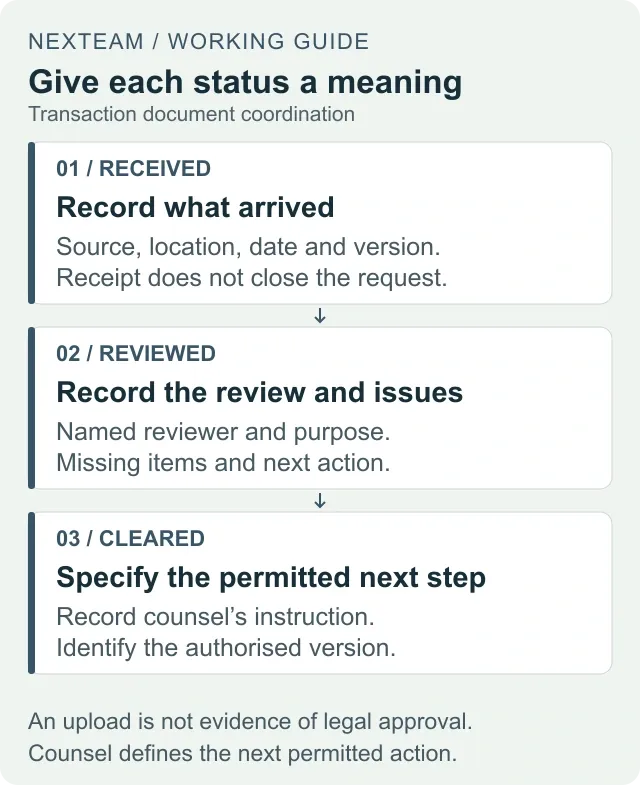
Received: the file is stored in the approved location, with its source, date and version identified. Receipt does not mean it is complete or acceptable.
Reviewed: the assigned reviewer has checked it for the agreed purpose. Questions, missing items and required revisions are recorded. The item may still need further work.
Cleared for the next step: counsel or the authorised reviewer has given a specific instruction, such as permission to circulate a particular version. Record the instruction and its scope. Clearance for circulation does not automatically mean clearance for signature or release.
Avoid automatic status changes based only on an upload or a signature notification. The supervising team should decide what evidence allows a request to move forward.
Make one tracker entry useful to the next person
Consider this illustrative entry, using fictional document details:
Request: provide the executed customer agreement and its schedules.
Received: a PDF from the authorised company contact, stored in the matter folder with its receipt date and version.
Open item: Schedule B is referenced in the agreement but is not included in the file received.
Next action: the coordinator requests the missing schedule through the agreed contact. The assigned lawyer reviews the response and determines whether the request has been satisfied.
Status: received; review remains open. The next follow-up date is recorded separately from any legal deadline confirmed by counsel.
Someone joining the matter can now see what exists, what is missing and who needs to act. The record also avoids turning a support person's observation into a conclusion about the agreement's legal effect.
Agree access, versions and escalation
Use the firm's authorised document systems and individual access permissions. Counsel and the relevant system owner should decide who can see, upload, amend or share records, including the treatment of confidential or potentially privileged material.
Set a naming and version convention before the document volume grows. Preserve the source record, identify the current working version and record which version was approved for the next action. Follow the firm's retention and document-control procedures when handling superseded material.
The brief should also explain what to do when something is uncertain. A discrepancy between versions, a request from an unfamiliar recipient or a deadline without a confirmed source needs escalation to the named reviewer. Support staff should have a clear route for asking, rather than guessing or circulating material to resolve the uncertainty themselves.
Assess the working method with a fictional exercise
A short work sample can show how a candidate organises information. Use fictional documents or material approved for the exercise. Provide a small bundle containing a duplicate file, a revised version and an obvious missing attachment.
Ask the candidate to prepare:
- An index: file names, versions, sources and locations.
- An open-items log: what is missing, the proposed follow-up and the assigned reviewer.
- A handover note: what they have checked and what remains for counsel to assess.
Review whether they preserve uncertainty, identify the right next action and keep legal conclusions within the supervising lawyer's remit. An exercise focused on document coordination should not require the candidate to provide independent legal advice.
Write the supervision into the assignment
The final brief should name the supervising lawyer, describe the transaction context, list the permitted tasks and specify the systems, working hours and review cadence. Include who confirms deadlines and who can authorise circulation, signature coordination and release.
For a wider transaction team, define how legal support exchanges requests with finance and commercial colleagues. Those colleagues may supply records and explanations; counsel determines what legal review or approval is needed.
Scoping transaction support? Discuss the assignment with Nexteam. Bring a task list and a named supervising lawyer so the required experience and working arrangements can be assessed. The client and supervising counsel retain management and review responsibility, with the scope confirmed for the relevant jurisdiction and matter.