


The monthly pack is almost ready. One portfolio company has submitted a revised file. Another has changed its EBITDA adjustments. A third has sent a revenue number without saying whether it is monthly or year to date.
An analyst can put all three into the same slide format. Making the pack useful requires agreement on what the numbers mean, which version to use and who can accept the unresolved items.
Private equity portfolio reporting needs an owner for each handoff. The company supplies and validates its information. An analyst can coordinate collection, run agreed checks and prepare the pack. A designated reviewer decides whether it is ready for the discussion it will support.
Need capacity for that monthly workflow? Book a call about portfolio reporting support.
Define the decision before requesting the data
Start with the meeting and its purpose. Will the pack support a discussion about cash, performance against plan, operating priorities or items requiring management follow-up? The answer shapes the measures, commentary and timing the team needs.
This article focuses on a monthly portfolio-company operating review. Fund accounting, valuations and formal limited-partner reporting have their own requirements and approval processes. A company-level pack may supply information to those processes, but it does not complete them.
ILPA's 2019 Portfolio Company Metrics Template addresses periodic company-level information supplied by GPs to LPs. It illustrates the value of agreeing a consistent data request. The monthly workflow below is a proposed internal operating approach, not an ILPA template or compliance standard. Source: ILPA's Portfolio Company Metrics Template.
Keep the initial request focused. For each measure, identify the period, units, source, company owner and person who will review it. Ask what action the measure could inform. If nobody can answer, reconsider whether it belongs in this pack.
Write down what each number means
A shared column heading does not establish comparability. “Revenue” might arrive as a monthly figure in one file and a year-to-date total in another. Cash could refer to different dates or accounts. An adjusted earnings measure may include different adjustments across companies.
Use a short metric dictionary and preserve company-specific definitions where they matter. An analyst should flag differences and prepare a proposed reconciliation for review. They should not silently relabel unlike figures as comparable.
| Field | What to specify |
|---|---|
| Measure and definition | The agreed calculation, included entities and relevant exclusions. |
| Period and units | Monthly, year to date or another stated period; currency and scale. |
| Source and version | File or system reference, extraction date and the version used. |
| Status | Whether the figure is submitted, checked, estimated or awaiting resolution. |
| Owner and reviewer | Who can answer questions and who accepts it for this reporting purpose. |
If the definition changes, record the change and its effect on the comparison. Keep the earlier version available. A clean chart should not conceal a break in the underlying series.
Make the handoffs visible
The roles below form one possible ownership model. A small firm may combine roles; it still needs to identify who prepares, who validates and who approves.
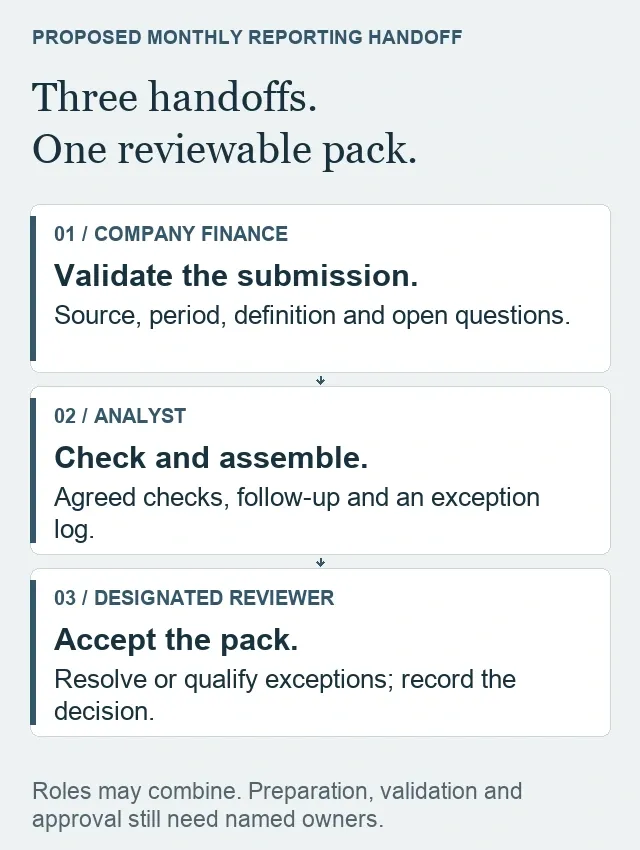
Portfolio-company finance owns the submission. It identifies the source, confirms the reporting basis and explains material changes or open items. The accountable company finance lead remains the escalation point when a number or explanation needs clarification.
The analyst owns the agreed preparation work. That can include maintaining the request tracker, following up on missing items, checking definitions and periods, comparing with prior submissions and drafting commentary from supported explanations. Questions remain visible until someone with the relevant knowledge answers them.
The designated reviewer owns acceptance for the meeting. This might be a fund finance lead, operating partner or another named person, depending on the pack's purpose. They decide which exceptions require resolution before release and which can be presented with a clear qualification and next action.
An investment conclusion or management action remains with the person authorized to make it. Preparing the report does not transfer that authority to the analyst.
Use an exception log to protect the review
Consider an illustrative example. A company submits a monthly adjusted EBITDA figure. Its explanation mentions a one-time cost, but the supporting bridge has not arrived. The meeting is approaching.
The analyst records what was submitted, preserves the reported amount and asks company finance for the adjustment bridge. The log identifies the missing evidence, its owner and the time by which the reviewer needs a response.
If the evidence is still missing, the reviewer chooses the treatment for this pack: obtain clarification before release, retain an explicitly qualified submitted figure or defer the comparison. The analyst records that decision. A blank field remains missing information; it should not become zero merely to make a table complete.
A useful exception record names the issue, its effect on the pack, the next action and the person responsible.
Keep explanations as disciplined as figures. “Revenue was below plan” describes a variance. A proposed explanation from management should be identified as such, with any checks or unresolved questions visible. Avoid converting a plausible story into a confirmed cause.
Agree a reporting calendar the companies can meet
Work backward from the review meeting and allow time for company submissions, analyst checks, questions and final acceptance. The dates should reflect how the companies actually close their books and produce information.
For each step, agree what must exist before work moves on:
- Request issued: definitions, period, source expectations, deadline and company owners are clear.
- Submission received: the tracker records the version and any missing items; receipt alone does not mean validation is complete.
- Checks completed: the analyst records the agreed checks and sends the exception list to the relevant owners.
- Review completed: the designated reviewer accepts the pack or identifies required changes and the treatment of open items.
- Released and recorded: the final version, review record and follow-up actions are stored where the team can find them.
When a company sends a replacement after release, record what changed and which version it supersedes. Make the effect visible to the people using the pack. A reporting process also needs a reliable way to correct its output.
Give analyst support a defined monthly remit
A workable brief could cover maintaining the reporting calendar, coordinating requests, running documented checks, assembling the pack and maintaining the exception log. Specify the companies in scope, system access, complexity of the measures, review owner and escalation route.
Download the monthly reporting handoff brief to scope that work. The reporting request and exception tracker provides an editable starting point; its sample rows are illustrative and contain no portfolio-company results.
If company finance cannot produce reliable source information, an analyst preparing a consolidated pack cannot resolve that alone. Clarify the underlying accounting and review responsibilities first. Our guide to building a finance team after an acquisition covers that wider staffing decision.
For the investment team's broader work allocation, see private equity analyst support.