


The group has acquired another business. Its finance manager knows why a major customer pays late, which supplier invoices need checking and where the previous owner made manual adjustments. The platform wants a consistent close, a cash forecast and comparable margins across every company.
Both needs are legitimate. Moving the finance manager into a group reporting role does not make the local work disappear. Hiring a group analyst does not automatically make the local records comparable.
A buy-and-build finance team needs a deliberate division of work: group leadership sets the requirements, named professionals prepare and review the outputs, and local colleagues supply the operating context and decisions that cannot be inferred from a ledger.
The staffing question is therefore more specific than “Should we centralise finance?” It is: which responsibility should move, who will receive it, and what must be working before the handover?
This guide helps portfolio-company CFOs and operating partners answer that question below the executive layer: AP, AR, accounting, consolidation, controller oversight and FP&A.
1. Let the acquisition strategy shape the finance team
A group buying similar businesses to combine operations has different needs from a group preserving independent brands and local management. Both may need consistent financial information. They may not need identical processing teams or one immediate system migration.
Bain’s 2024 buy-and-build analysis argues for a clear strategic reason to combine the businesses and the capabilities to execute it. For finance staffing, translate that rationale into the information, controls and recurring work the combined business actually needs.
| Acquisition rationale | Finance capability to examine |
|---|---|
| Combine similar operations | Common close requirements, consistent account mappings and a workable shared processing model. |
| Cross-sell to existing customers | Reliable customer and product definitions, with local commercial owners explaining the opportunity and its progress. |
| Expand into a new geography | Group visibility alongside people qualified to handle local accounting, payroll, tax and filing requirements. |
| Preserve independent businesses | Comparable reporting and clear oversight, with a defined local finance remit. |
| Acquire a new business model | Accounting and analytical experience relevant to the new revenue, cost and working-capital patterns. |
These are starting points for scoping work, not five standard organisation charts. A group can use different arrangements for different processes.
Before designing the future team, list the outputs already promised to the board, lenders and operating leaders. Identify the source, preparer, reviewer and decision-maker for each. Our PE 100-day finance plan includes an editable staffing planner for this first pass.
2. Separate group authority, shared execution and local context
“Group owns AP” is incomplete. It might mean group sets the policy, runs the invoice queue, approves spending, releases payments or all four. Those responsibilities require different authority and different evidence.
Use three layers to describe the work. They are responsibilities, not mandatory departments or locations; a smaller group may assign several to the same people where capacity and controls permit.
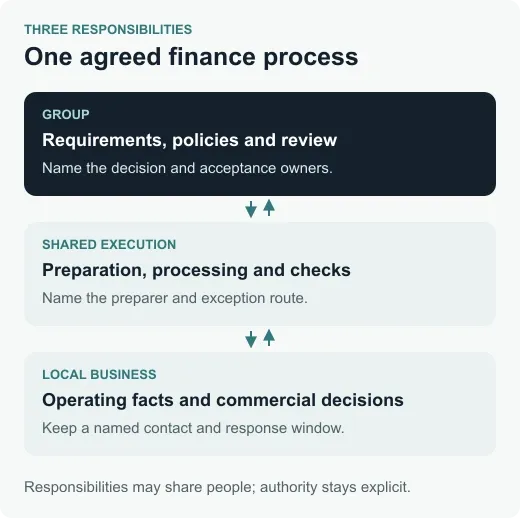
Group: define and accept
Group finance establishes the reporting requirements, accounting policies, close calendar and group-level review arrangements. It brings entity information together, assesses exceptions and supports decisions about cash and performance. Delegated authorities must say who can approve what.
A group controller may own this work, while the CFO retains wider financial leadership. The title alone does not settle the split: specify whether the controller will prepare schedules, review entity work, manage staff, lead consolidation or cover a combination.
Shared team: prepare and process
A shared team can maintain agreed transaction queues, reconcile accounts, prepare close schedules and assemble reporting inputs. It might sit at the platform company, work remotely across locations or use a specialist provider for a defined service.
Its remit needs clear inputs, service windows, exception routes and a reviewer. “Send everything to the centre” leaves those decisions unresolved.
Local business: explain and decide
Local colleagues confirm receipt of goods or services, explain customer disputes, provide operating assumptions and own the commercial actions assigned to them. A finance process can move while some of these responsibilities remain local.
McKinsey’s work on corporate functions highlights the duplication that follows ambiguous boundaries between a business unit and a central function. Make the boundary explicit for each output rather than assuming an org chart resolves it.
3. Map the handoffs process by process
The useful design detail is where work changes hands. Start with the processes causing delays or repeated questions. The following is an example allocation to adapt to the group's legal structure, systems and approval rules.
| Process | A workable division of responsibility |
|---|---|
| Accounts payable | Group: policy and approval framework. Shared team: invoice processing, reconciliations and payment proposals. Local: receipt confirmation and commercial exceptions. Authorised approvers retain payment approval and release. |
| Accounts receivable | Group: credit and reporting requirements. Shared team: billing or cash application where scoped, ageing and agreed collections follow-up. Local: service disputes, customer commitments and commercial decisions. |
| Entity close | Group: timetable, policies and review requirements. Accounting team: specified reconciliations, journals and schedules. Local owners: estimates and operating explanations. Name the person who accepts each entity submission. |
| Consolidation | Group: consolidation method and final acceptance. Consolidation accountant: mappings, intercompany checks and consolidation schedules within their competence. Entity teams: supported balances, counterparties and explanations. |
| Forecasting | Group FP&A: common definitions, model and consolidated scenarios. Local managers: operating drivers and actions. Analyst: collect, challenge and reconcile assumptions before preparing the agreed view. |
| Statutory, tax and payroll work | Name the appropriate local or specialist owners, filing responsibilities and group reviewer. Group reporting does not replace entity obligations or required professional expertise. |
Consider one invoice exception. The shared AP professional can identify that the purchase order and invoice disagree. They may not know whether the supplier completed the work or whether the site manager negotiated a price change.
The handoff should therefore identify the local person who answers that question, the response window and the escalation if the invoice approaches its due date. It should also show who updates the record and who approves the eventual payment.
That is a complete process. Simply relocating the invoice queue moves the unresolved questions with it.
Decide which local knowledge must travel with the work
Before transferring a process, capture recurring exceptions, important contacts, undocumented adjustments and the reasons for current practices. Some practices should change; first understand what problem they were solving.
Ask the outgoing owner to work through real examples with the receiving professional. An SOP helps, but a walkthrough of an unusual credit note, an intercompany mismatch or a disputed supplier balance exposes the judgement the procedure may omit.
Retain a named local contact during the transfer, with time allocated for questions. Do not remove their capacity from the plan while still relying on them to explain every exception.
4. Give acquisition integration its own capacity
Recurring finance work and acquisition integration compete for the same experienced people. Every add-on brings another set of opening balances, mappings, access requests, policies and reporting expectations. The previous acquisition may still be generating corrections when the next one closes.
RSM’s guidance for PE-backed finance functions identifies consolidation, policy alignment, forecasting and system integration among the demands created by buy-and-build. Treat that work as a capacity requirement alongside normal operations.
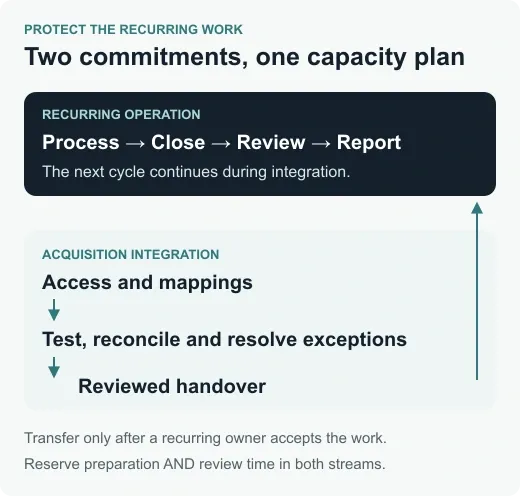
Create two visible work lists:
- Recurring operation: processing, payments, collections, close and reporting that continue each cycle.
- Integration: finite tasks with an owner, a reviewer, a completion criterion and a receiving owner after handover.
The people can overlap, but their calendars must reconcile. If the controller spends the close week reviewing a new entity's mappings, show who covers the review they would otherwise perform.
An integration lead coordinates dependencies and readiness. That does not automatically make them the qualified reviewer for purchase accounting, tax or a complex consolidation issue. Technical ownership remains explicit.
INSEAD’s 2025 discussion of buy-and-build, based in part on interviews with three European PE firms, emphasises dedicated integration support and deliberate collaboration. It offers useful examples, not a universal staffing ratio or timetable.
Keep an integration queue, not just a deal calendar
For each acquisition, record the next finance milestone, unresolved dependency, expected reviewer and work still needed before it becomes routine. Review this queue before adding another set of commitments.
An acquisition being legally complete is different from its first group close being accepted. A useful staffing discussion shows both dates and the remaining work between them.
5. Hire for the point where work is waiting
There is no reliable rule that the third acquisition requires a group controller or the fifth requires FP&A. Complexity, current capability, transaction volume, systems and reporting demands matter more than the acquisition count alone.
Start with the waiting work and test whether the cause is capacity, capability, an unavailable input or unclear authority.
| Observed constraint | Role to consider and the first assignment |
|---|---|
| A consistent process exists, but transaction queues are growing | AP or AR specialist: own a defined queue and exception log, with named approval and escalation routes. |
| Entity close schedules arrive incomplete or unsupported | Senior accountant: take ownership of specified balances and close schedules; identify unresolved items for the reviewer. |
| Entity books are sound, but group consolidation depends on repeated manual rescue | Consolidation or group accountant: maintain mappings, intercompany checks and the supported consolidation process. |
| Preparation is adequate, but policy decisions and review are stuck with the CFO | Group controller or experienced controller: take the defined review and control remit, with decision authority agreed in advance. |
| Every add-on repeatedly displaces the recurring team | Finance integration lead or project specialist: coordinate a bounded onboarding plan and handover. Add technical specialists where the work requires them. |
| Reliable numbers exist, but management lacks a usable forecast or performance explanation | FP&A professional: build or own a defined decision pack with operating input owners and an agreed review cycle. |
More than one gap may exist. Choose the sequence that removes the dependency blocking the next important output.
For example, an analyst cannot produce a defensible service-line margin view if costs are not reconciled or consistently assigned. The first addition may be accounting preparation capacity. If reliable inputs already exist and the controller can review them, analytical capacity may be the better next hire.
Do not hire around an unresolved management decision. Duplicate reporting requests, missing access and disputed approval rights need an owner and a decision. A new professional should not inherit responsibility for fixing an authority gap they cannot control.
6. Test the model on an illustrative third acquisition
Imagine an industrial-services platform with two businesses using a shared close calendar. A third business is acquired with a different accounting system. Its local finance manager still prepares reconciliations and understands contract billing. The platform controller reviews the group close. The CFO wants consolidated cash visibility and a comparable margin view.
The tempting brief is “Hire one person to integrate the acquisition and improve reporting.” Break it into work products before choosing the person.
| Work product | Assignment and acceptance |
|---|---|
| First entity reporting submission | Local finance explains the records and exceptions. A senior accountant prepares agreed schedules and mappings. The platform controller reviews and accepts the submission. |
| Group cash view | An assigned accountant or analyst assembles supported balances and expected flows. Local owners explain collection and payment timing. The finance lead reviews assumptions and open items. |
| Comparable margin view | Accounting establishes usable inputs; operations agrees the relevant drivers and explains differences. FP&A prepares the analysis and makes limitations visible for review. |
| Integration handover | A named lead tracks access, mappings, testing and unresolved issues. Recurring owners accept the transferred processes and the support they need. |
If the platform controller has review capacity but the local manager is overloaded with preparation, a senior accountant may be the first addition. If review is already the delay, adding preparation without strengthening review can increase the waiting queue.
The margin analysis may need a separate assignment after its inputs are usable. That is not a reason to postpone planning for FP&A; it is a reason to align its start and first deliverable with the dependencies.
Keep the local manager involved in operating discussions and exception decisions during the transfer. Confirm what their continuing role will be. “We still need your knowledge” is not a workable plan if the role has simultaneously been removed from the future structure.
7. Transfer a process when it is ready
Separate a common reporting requirement from a common ERP. A group can define a reporting pack and controlled account mappings while entities still use different systems. It must also fund the reconciliation and maintenance that this arrangement requires.
A new ERP may help the intended model. Its implementation also consumes finance time for data preparation, testing and reconciliations. Put that work in the integration plan and keep a usable interim process until the replacement has been accepted.
McKinsey’s merger operating-model guidance recognises that interim arrangements may be needed before the final model is achievable. Give the temporary arrangement its own owners and review date.
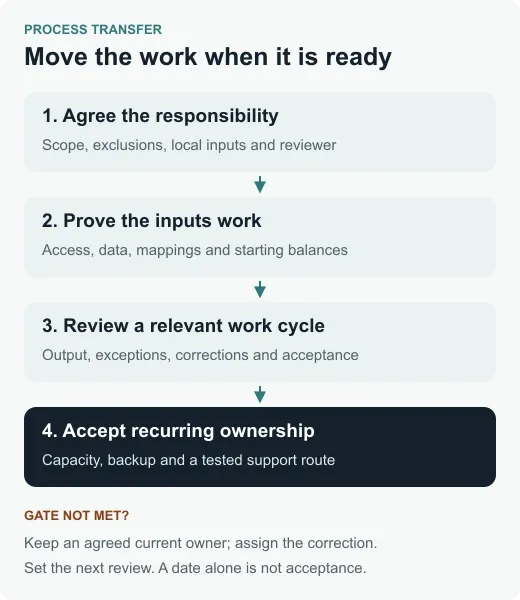
| Readiness gate | Evidence to bring before transfer |
|---|---|
| Scope is agreed | Named entities, transactions, exclusions, service windows and continuing local responsibilities. |
| Inputs and access work | Reconciled starting position where relevant, usable source data and tested individual permissions. |
| Review and exceptions work | A qualified reviewer, approval boundaries and a local escalation route that has been used in practice. |
| A relevant cycle has been tested | Prepared output, recorded review, visible unresolved items and a decision on their treatment. Test the risks of the process; one routine cycle may not cover them all. |
| Continuing ownership is accepted | Receiving owner, capacity, backup coverage, documentation and an agreed fallback for a failed handover. |
Treat “not ready” as an action list. Record the missing condition, owner and next review. A calendar deadline alone is not evidence that the receiving team can operate the process.
8. Account for the work that centralisation leaves behind
A central team may remove repeated effort, improve consistency or add capability that no entity could support alone. Assess the full workload before presenting a staffing saving.
Use two capacity views so that a temporary transfer cost does not disappear into the recurring staffing assumption.
| Capacity view | Work to include |
|---|---|
| Continuing operation | Shared-team execution, local responsibilities that remain, group review, exceptions, system administration and routine coordination. |
| Transition period | Migration, cleanup, testing, parallel running, training and extra review while the receiving team learns the business. |
| Work expected to stop | Name the duplicate report, manual step or old queue, its retirement condition and the person who confirms it is no longer needed. |
| Capacity added for a new capability | Identify the forecast, analysis or oversight that did not exist before, plus its preparation and review needs. |
If the old team still rebuilds every report to answer its own operating questions, the work may have been duplicated. Either the group output does not meet the business need, or the old process has not been formally retired. Resolve that with the users of the information.
After a handover, review practical evidence: whether outputs arrive on time, whether reconciliations are supported, where exceptions wait, how much rework is required and whether a second person can cover the process. Compare like-for-like cycles and distinguish normal operations from transition work.
That review may support another hire. It may instead show that the next improvement is a better input, fewer duplicate requests or a clearer decision route.
9. Make remote professionals part of the operating team
Geography is a separate decision from ownership. A remote senior accountant can work inside group finance. A remote analyst can support a local business leader. The reporting line, scope and review arrangements still need to be explicit.
Nexteam connects clients with professionals who integrate into their teams. The client directs the work. Define the manager, systems access, working overlap, first assignment and reviewer before the person starts. If the requirement is a provider accountable for a finished service, scope that deliverable-based model separately.
Use a weekly 30–60-minute one-to-one with agenda items from both sides, plus the relevant weekly team or project meeting. Include the person in close discussions and operating updates where their work depends on them. Quarterly reviews can cover what to start, stop and continue. Adjust additional check-ins to the work rather than using meeting volume as a proxy for supervision.
Start with a well-defined deliverable that exposes the professional to the firm's actual workflow. Expand to recurring ownership after accepted work and demonstrated understanding. Our 30–60–90-day onboarding plan develops that progression.
Turn the operating model into the next hiring brief
A useful brief identifies the business being supported, the first work product, the dependency that is holding it up and the person who will accept it. Include the systems, local contacts, review windows and responsibilities that will remain elsewhere.
Before starting the search, complete this sentence:
We need this professional to own [work product or process] for [entities], using [systems and inputs]. [Manager] sets priorities, [reviewer] accepts the output, and [local owner] resolves operating questions. Once the first cycle is accepted, the role expands to [continuing remit].
Use the PE finance staffing planner to test that brief against the team's weekly preparation and review capacity. Then explore controller hiring, accounting support or financial analyst and FP&A hiring against the actual remit.
The next acquisition should enter a finance team that knows how work is assigned, reviewed and transferred. Build that capability one accepted responsibility at a time.