


A private equity 100-day plan can look fully staffed because every finance initiative has the CFO’s name beside it. Then the first close arrives. The same person is reconciling an inherited balance, answering sponsor questions, reviewing the cash forecast and trying to start the margin analysis.
The plan has an accountable executive. It may still be missing the people who will do the work.
Before opening a search, identify whether the delay comes from preparation, review, missing inputs or a decision nobody has made. Those gaps call for different responses. A senior accountant, a controller and an FP&A analyst can all support the plan, but they are not interchangeable hires.
This guide is for the CFO and operating partner staffing portfolio-company finance after an acquisition. It covers the first assignment, the management capacity it needs and the work that remains after day 100.
1. Put the deal plan beside the day job
An acquisition adds demands without cancelling payroll, collections, supplier payments or the close. Map three kinds of work onto the same calendar, including the weeks when they collide. Mark obligations with fixed dates, including required filings and lender reporting where applicable, before allocating time to discretionary projects.
Run the business
Recurring close, billing, collections, payments and reporting. Record the due dates and the people already committed.
Repair inherited issues
Unsupported balances, inconsistent mappings or missing inputs. Separate a finite cleanup from a process creating new problems every month.
Build the new capability
Forecasts, margin analysis and reporting needed for the value-creation plan. Identify the source data and review each output depends on.
An FP&A hire asked to build a pricing model may first spend weeks reconciling product data. That preparation may be necessary, but it belongs in the plan. Otherwise the sponsor expects analytical capacity while the business is still repairing the inputs.
Deloitte’s finance diagnostic guidance considers people, processes, data and technology together. Use that diagnostic approach before treating every delay as a headcount problem.
For the broader AP-to-FP&A coverage map, see building a finance team after an acquisition. For the 100-day plan, narrow the question to the next output that needs to become usable.
2. Find the constraint before choosing the title
“Improve reporting” is difficult to hire against. “Produce a reconciled margin view by service line before the pricing meeting” identifies an output, a reader and a deadline.
Someone may need to reconcile the costs. A commercial leader may need to approve an allocation. A qualified reviewer may need to resolve exceptions. Hiring an analyst does not automatically solve all three.
McKinsey’s talent-to-value approach starts with the business agenda and the work it requires, then identifies the roles that matter. Apply that logic below the executive team as well.
| Responsibility | Name the person who… |
|---|---|
| Accountable executive | Owns the business result and can change priorities. |
| Person doing the work | Produces the output and coordinates the inputs. |
| Reviewer | Assesses the work and accepts it for its intended use. |
| Decision owner | Approves the accounting, commercial or funding action that follows. |
One person can hold multiple responsibilities where workload and controls permit. Repeating “CFO” in every row should trigger a capacity discussion. Titles also cover different scopes: a controller in a smaller business may still prepare significant work. Assess the actual responsibilities and capability, not an assumed hierarchy.
Now look at where work is waiting. The following situations are illustrations, not client case studies.
Preparation is the constraint
The CFO still prepares close schedules; a qualified reviewer is available. Assess a senior accountant, or a narrower AP/AR role if transaction processing is the actual problem.
Analysis is the constraint
Actuals are reliable, but the CFO builds every forecast and margin analysis. Assess FP&A or financial analyst capacity with the necessary operating relationships.
Review is the constraint
Schedules are prepared, but only the CFO can resolve exceptions and accept the pack. Assess a controller, assistant controller or experienced specialist for the agreed scope.
| Profile to assess | First scope to define |
|---|---|
| AP / AR specialist or staff accountant | Own a billing, collections or payment-preparation queue, routine exceptions and escalations. |
| Senior accountant | Own specified close schedules, reconciliations and supporting records. |
| Controller or assistant controller | Review named accounting areas, resolve exceptions and coordinate the close. |
| FP&A professional or financial analyst | Maintain a forecast or decision pack with agreed operating input owners. |
| Project or interim specialist | Complete a bounded technical transition against acceptance criteria and hand it over. |
A no-hire decision belongs in the plan too. Standardise duplicate sponsor reports. Resolve missing access. Agree who approves the assumptions. Stop or defer lower-priority analysis. Another person cannot fix a decision that management has not made.
Worked example: the pricing review that is waiting on finance
Suppose the investment plan calls for a pricing review by service line. Revenue is recorded consistently, but delivery costs are not mapped reliably. The CFO has been asked to produce the analysis while also preparing the close. This is an illustrative situation.
First, separate the dependencies. Operations must explain how delivery effort is recorded. Accounting must reconcile the costs and flag exceptions. FP&A can then analyse margin using an agreed allocation approach. Management still owns the pricing decision.
If a capable analyst and reviewer are already available, the missing hire may be the senior accountant who takes over close preparation and makes the input schedules usable. If the data and close are already sound, the missing capacity may instead be FP&A. If nobody can resolve the accounting exceptions, more preparation capacity alone will not clear the path.
The first assignment should be bounded: one agreed service-line view, reconciled inputs, explicit assumptions and a list of unresolved items for review. Expand coverage after the process works. This gives the hiring discussion something more precise than “we need someone to support value creation.”
3. Test how much manager time the hire releases
A new professional needs context, access, feedback and someone available to resolve exceptions. Their contracted hours are not the same as hours released for the CFO.
Compare the manager’s time before and after a specific handoff in comparable weeks, with similar workload and quality requirements. Include preparation, review, onboarding and coordination on both sides.
| CFO hours / week | Before | After |
|---|---|---|
| Preparation | 10 | 0 |
| Review | 2 | 3 |
| Onboarding and context | 0 | 3 |
| Coordination | 0 | 2 |
| Total | 12 | 8 |
| Net time released | — | 4 |
Illustrative calculation: 12 − 8 = 4 hours released. These are planning assumptions, not a benchmark or measured client result. If onboarding takes ten hours instead of three, the CFO initially spends three more hours than before. That may be a sensible transition investment; it should be budgeted honestly.
Re-estimate after completed work cycles. An experienced hire may need less technical instruction while still needing substantial business context. Decide what the released time will enable: an operating review, a forecast discussion or another specific priority.
Then check the new professional’s capacity and the reviewer’s calendar. Ten available hours spread across a week cannot necessarily cover work that must happen between Thursday’s data delivery and Friday’s review. Do not add spare hours across different people and assume skills, authority or timing are interchangeable.
Capacity released and capability added are different business cases. If an FP&A hire creates the first usable rolling forecast, there may be little existing work to hand over. Assess the new output against the decision it supports, while budgeting the additional review time. The manager-hours calculation is useful for a transfer of existing work; it does not capture the whole contribution of a new capability.
4. Work backward from the first accepted output
“Start recruiting in month two” is inadequate if the output is also due in month two. Set the date when the work must be accepted, then work backward through the dependencies.
1. Accepted output
What must the decision-maker be able to use, and by when? Define the quality threshold and unresolved issues that must be disclosed.
2. Review and rework
Reserve a qualified reviewer and time to resolve comments before that deadline.
3. Preparation and inputs
Confirm when data, operating assumptions and relevant access will actually be available.
4. Useful start date
Allow for business context, a relevant work cycle, actual search conditions and any notice period. Confirm what can run in parallel.
There are two clocks. Transaction day 70 can be a new employee’s day 1. Assess readiness from their start and completed work cycles, rather than expecting 70 days of knowledge on arrival.
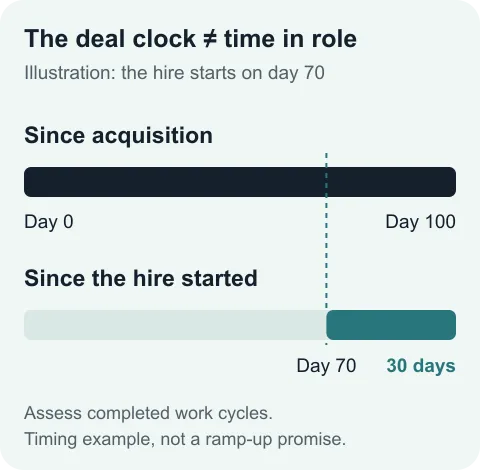
If the useful start date has already passed, agree a response: temporary cover, a narrower first output or a revised deadline. Recruiting urgency does not remove onboarding dependencies.
Use these transaction milestones as review points, adjusting them to the deal, obligations and hiring timing:
| Review point | Evidence and next decision |
|---|---|
| By day 30 | Bring priority outputs, recurring commitments, review owners and the observed gap. Decide what to stop, reassign, cover temporarily or recruit for. |
| By day 60 | For work underway, review completed cycles, comments, support time and dependencies. Adjust scope, seniority, sequencing or reviewer support. |
| By day 100 | Review recurring ownership, open issues and next-quarter workload. Confirm the continuing role, temporary work and what remains with the CFO. |
A filled position or finished dashboard is not sufficient evidence of completion. For a reporting pack, check that figures tie to the agreed sources, an appropriate reviewer has accepted the work, open issues are visible and the next cycle has an owner. Our portfolio reporting guide develops those requirements.
For a person joining later in the transaction, use a separate 30–60–90-day onboarding plan. Assign broader ownership based on their completed work and readiness.
5. Test the role against day 101
The deadline can make every gap feel permanent. Separate work that ends from work that repeats before approving a continuing role.
| Initial assignment | Possible continuing ownership |
|---|---|
| Clean up opening reconciliations | Maintain reconciliations and coordinate the recurring close. |
| Build the forecast template | Obtain inputs, update assumptions and explain variances each cycle. |
| Produce the first sponsor pack | Maintain definitions, source support and a predictable reporting process. |
| Resolve a specific migration issue | A bounded handover, if the regular team can own the process afterward. |
Ask what the person will own in month six. Recruit for that continuing work as well as the immediate assignment. Where the need is bounded, define the project end point, handover and review date.
For a carve-out, technical accounting issue or systems transition, compare a specialist project or managed delivery arrangement with adding an individual to the team. The service scope, access and acceptance responsibilities must be explicit. An integrated hire fits a client-led role; it does not by itself provide a complete finance operating model. EY’s discussion of acquisitive finance teams provides the managed-services perspective on this choice.
Build the case around the full cost: compensation or engagement fees, recruiting, systems, manager time, transition overlap and any interim cover. Time released is useful; it is not automatically cash savings or an EBITDA improvement. Do not convert an assumed hourly saving into a valuation claim.
6. Turn the plan into a credible hiring brief
For a senior accountant whose main purpose is to remove a close-preparation constraint, the brief could look like this. Replace the example with the company’s actual environment.
| Brief field | Illustrative senior accountant scope |
|---|---|
| Purpose | Own agreed close preparation so the controller can review an organised pack and the CFO can focus on forecasting. |
| First assignment | Prepare named reconciliations for one entity, tie them to source records, document exceptions and coordinate review. |
| Essential environment | Specify ERP, entities, accounting framework, currency, source quality and relevant industry experience. |
| Reviewer and boundaries | Name the reviewer and the entries, estimates and changes requiring approval. Keep payment release with authorised people. |
| Acceptance | Traceable support, resolved review comments and named owners for outstanding exceptions. |
| Continuing role | The accounts, schedules and coordination the person will own after the initial cleanup. |
Separate experience essential on arrival from knowledge the person can reasonably acquire. PE experience can be useful, but it does not establish fit with this ERP, accounting scope or operating complexity.
Spencer Stuart’s PE CFO selection research cautions against relying on prior PE experience alone. That research concerns CFOs. Our recommendation for roles beneath the CFO is to assess the actual work and environment rather than use a PE employer name as the main filter.
Senior accountant assessment
Use a short synthetic reconciliation. Ask the candidate to identify unsupported items, organise questions and explain the proposed next steps.
Controller assessment
Show competing close exceptions. Ask what they would review first, delegate and escalate, with reasons and boundaries.
FP&A assessment
Use a small forecast scenario. Test reconciliation to actuals, assumption quality and how the result changes a business decision.
Use synthetic or properly redacted material and a proportionate exercise. Follow up on the reasoning. The goal is evidence of relevant capability, not a polished file produced without understanding.
7. Integrate the hire into the client team
An integrated remote finance professional needs the same operating context as other team members: a manager, relevant colleagues, approved systems, clear priorities and review access.
Nexteam’s role is to help clients find the professional. The client leads the work and retains the agreed review and approval responsibilities. This is different from commissioning a finished output from a delivery provider; the two models require different working arrangements.
Once the scope is clear, explore financial controller hiring or financial analyst and FP&A hiring against the responsibilities your team needs covered.
Weekly manager meeting
Set a 30–60-minute one-to-one with an agenda from both sides: work, blockers, feedback and the next responsibility to transfer.
Weekly team or project meeting
Include the professional in the relevant team discussion so they understand colleagues’ work and dependencies.
Work-specific overlap
Plan overlap around inputs, decisions and review windows. Add brief operational check-ins during close when the work requires them.
The sponsor also affects capacity. Consolidate information requests through an agreed lead, distinguish urgent decisions from interesting analysis, and decide what moves when a new priority arrives. Bain’s guidance for newly acquired companies recommends a primary sponsor liaison and recognises the additional FP&A demand ownership can create.
A weekly priority conversation should include a stop-or-defer decision when capacity is full. A new hire should not become the recipient of an unlimited queue.
8. Bring a staffing decision to the next review
Choose one important output. Bring its deadline, the four responsibilities, the missing dependency and the proposed action. Test the peak week and what the role will own after day 100.
Your recommendation may be a hire, temporary specialist, reassignment or a decision to stop lower-priority work. If a hire is justified, you now have a specific brief to discuss: what they will take over first, what experience matters and who will help them become effective.

Download the PE finance staffing planner →
Three editable sheets: hiring decision, weekly capacity and manager handoff. The examples are illustrative; the workbook does not recommend headcount or calculate investment returns.