


The close is finished, but the CFO still has to explain why cash collections, receivables and the general ledger tell different stories. Every new location adds another spreadsheet, another exception and another person to chase.
For a growing healthcare business, the hiring question is often about who owns the reliability of the numbers. A healthcare financial controller can connect the accounting work, revenue-cycle information and management reporting into a process the leadership team can use.
Start with the work that keeps coming back to the CFO
| What keeps happening | Where to look for capacity |
|---|---|
| Reconciliations wait because nobody has time to prepare them. | Accountant or senior accountant, if the process and review owner are already clear. |
| Prepared reconciliations carry unresolved differences month after month. | Controller to own review, correction and escalation. |
| Billing reports and ledger balances disagree. | Controller and revenue-cycle owner to explain timing, adjustments and interfaces. |
| Reliable numbers are available, but funding decisions remain open. | CFO, supported by the controller and FP&A. |
Hiring another preparer helps when the bottleneck is preparation. If nobody owns the close, review standards and unresolved accounting issues, adding more preparation capacity may leave the CFO with the same problem.
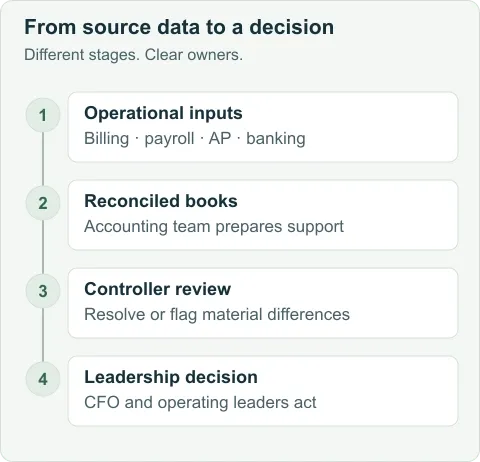
Give the controller a clear place in the team
A controller does not need to personally process every invoice, reconcile every account or chase every claim. The role needs enough authority to set the accounting calendar, challenge incomplete work and get exceptions resolved.
Here is a starting allocation to adapt to your business:
| Workstream | How responsibility is divided |
|---|---|
| Cash and balance-sheet accounts | Accountant: prepare reconciliations. Controller: review evidence, resolve differences and track open items. |
| Billing and collections | Billing team: own daily activity. Controller: reconcile financial reporting and escalate unexplained differences. |
| AP and vendor records | AP team: process work. Controller: review coding, cut-off and exceptions under agreed approval rules. |
| Financial statements | Accounting team: prepare schedules. Controller: own the close, review and release process. |
| Forecast and decisions | FP&A and CFO: own planning and decisions. Controller: supply reliable actuals and explain accounting movements. |
Payment authority, accounting-policy approval and material management decisions should remain explicit. A new title should not silently change who can approve a payment or release a report.
Build a reporting pack that explains the business
More tabs are not the objective. Each section should answer a management question and identify the person who can explain it.
| Pack section | What management should be able to see |
|---|---|
| Financial statements | Revenue, cost and balance-sheet changes, backed by a reviewed ledger and supporting schedules. |
| Cash position | Available cash and upcoming obligations, tied to reconciled bank balances. |
| Receivables | Aging and collection changes, reconciled to the ledger with adjustments explained. |
| Location or service-line results | Differences needing an operating explanation, using consistent mappings and allocation assumptions. |
| Open issues | Unresolved items, evidence, an owner and the date of the next update. |
For patient receivables, use consistent definitions before comparing results across periods or locations. HFMA's MAP Keys provides defined revenue-cycle measures, including receivables aging and net days in accounts receivable. Choose measures relevant to your provider model and document how your data maps to each definition. A movement in a metric starts an investigation; it does not establish the cause. HFMA MAP Keys
Test for healthcare operating experience
Ask a candidate to walk through a close they actually owned: the source systems, the review sequence, a recurring difference and how it was resolved. Listen for a clear distinction between work they prepared, work they reviewed and decisions they escalated.
Useful follow-up questions include:
- “Billing reports and the ledger do not agree. Where do you start?” Look for a structured reconciliation and an understanding of timing and adjustments.
- “What was still open when you issued the reporting pack?” Look for judgment about materiality, disclosure and follow-through.
- “How did you work with the billing team?” Look for collaboration with an operational owner, rather than a claim to control every function.
- “Which parts of our accounting system have you used directly?” Distinguish hands-on experience from exposure to reports exported by somebody else.
For a US healthcare operator, assess the US GAAP and operating-company experience your scope requires. Make system requirements specific: direct Dynamics GP experience, for example, is different from general Microsoft software familiarity. Do not make acquisition experience mandatory unless acquisitions are part of the actual job.
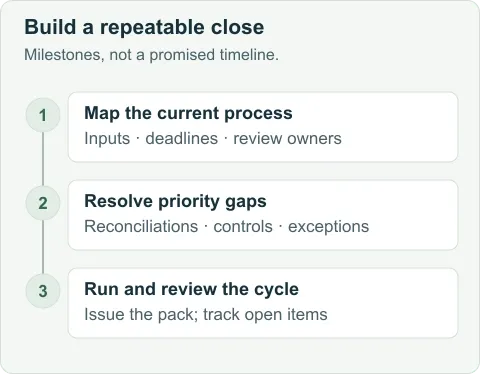
Start with ownership, then expand the scope
The first milestone should be a documented view of the close: inputs, preparers, reviewers, deadlines and unresolved issues. The next is a complete reporting cycle with agreed checks and visible exceptions. Broader forecasting or acquisition work can follow once the recurring foundation is dependable.
A remote controller needs the same access, team relationships and review authority as an on-site colleague. The client leads the person, sets priorities and connects them to the CFO, accounting and revenue-cycle teams. Agree the working-hours overlap around close reviews and operational decisions.
For a practical starting plan, see our 30–60–90-day guide. If the main gap is still unclear, compare senior accountant and controller responsibilities.
Looking for a healthcare controller?
Tell us which entities the role will cover, your accounting system, who currently owns the close and what the CFO needs to hand over. We can help define the scope and identify relevant finance professionals.

Prefer to start in writing? Email your role outline.
Explore remote financial controllers.