
Practical guide
How to Evaluate a Remote Accountant Before You Hire
Use a practical work sample, structured questions and an evidence rubric to evaluate staff and senior accountants before hiring.
Staff accountant hiring
Hiring a staff or senior accountant?
Choose staff or senior level, then tell us the work you need covered. Add your contact details at the final step.
Start with the work you need someone to own
A candidate can describe a month-end close fluently and still struggle to leave you a reconciliation you can review. Before hiring a remote accountant, look for three things together: relevant experience, a credible work sample and the ability to explain decisions and open items.
Define the assignment first. A staff accountant preparing schedules and a senior accountant reviewing the close should not face the same expectations just because both have “accountant” in their title.
| Responsibility | Staff accountant evidence | Senior accountant evidence |
|---|---|---|
| Reconciliations | Prepares a supported reconciliation and lists unresolved items. | Reviews the preparation, investigates exceptions and identifies what prevents sign-off. |
| Journal entries | Proposes an entry with the source, amount and accounting rationale. | Challenges the treatment, considers related accounts and follows the approval process. |
| Close coordination | Completes assigned schedules and flags missing inputs. | Understands dependencies, escalates delays and owns an agreed part of the close. |
| Handover | Leaves a clear workpaper and concise status note. | Explains the decision needed, its implications and the appropriate reviewer. |
Swipe horizontally to see all columns.
Choose the expectations that match your actual role. See the scopes for a remote staff accountant and a remote senior accountant. A senior title does not automatically include payment approval, tax advice or responsibility for the entire finance function.
Separate experience, ability and practical fit
What have they owned?
Take one recent close or reconciliation. Ask what the candidate prepared, what they reviewed and who approved it. Establish the entities, transaction volume, systems and exceptions involved.
What can they demonstrate?
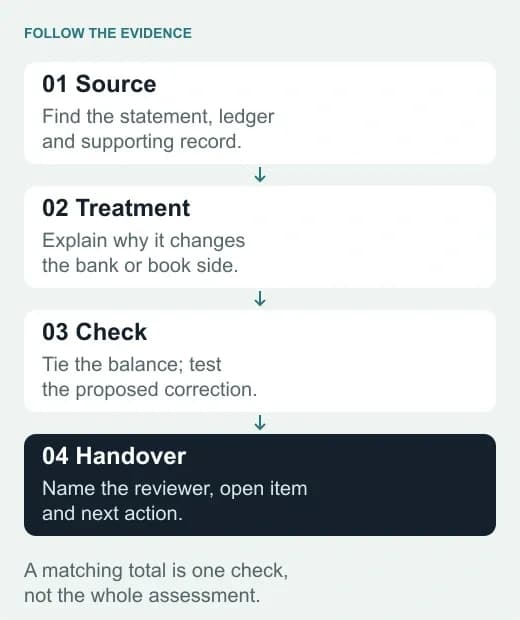
Review a small assignment linked to the role. Ask for the workpaper, proposed corrections and a handover note. Follow the calculation back to its supporting facts.
Can the arrangement work?
Confirm start date, capacity, working-hour overlap, rate and spoken and written communication separately. Technical strength does not establish availability or schedule fit.
Use the same core questions and evidence criteria for candidates considered for the same role. OPM describes structured interviews as job-related questions assessed against defined proficiency benchmarks; that is a useful discipline for the conversation, even when the hiring process is small. Source: OPM, Structured Interviews.
Use a short, realistic accounting work sample
For a reconciliation-heavy role, use the example below. It is a compact exercise with invented company data, not a test of every accounting skill. For revenue recognition, inventory or tax work, build a separate exercise around that responsibility.
A reasonable starting format is 30 minutes of preparation and a 15-minute discussion, adjusted for the role and candidate needs. Tell candidates the scope, time allowance and allowed tools in advance. CIPD recommends assessments that resemble the job and a selection process whose requirements are clear to candidates. Source: CIPD, Selection methods.
The brief: Prepare the September 30 cash reconciliation from the facts below. Show proposed journal entries and write a four-line handover to the controller. All figures are USD. Treat the supplied facts as verified; no other reconciling items exist in this exercise. Propose entries for review—do not assume authority to post them.
| Source fact · USD | Supporting detail |
|---|---|
| Bank balance: $126,480 | September 30 closing balance from the statement. |
| Ledger cash: $128,600 | September 30 balance before the adjustments below. |
| Deposit in transit: $8,000 | Recorded in the ledger on September 30; credited by the bank on October 2. |
| Outstanding check: $6,500 | Recorded in the ledger on September 29; cleared the bank on October 3. |
| Bank service fee: $120 | Debited by the bank on September 30; absent from the ledger. |
| Duplicate receipt R104: $500 | One real customer receipt; recorded twice as Dr Cash / Cr Accounts Receivable. Bank record and remittance confirm one receipt. |
Swipe horizontally to see all columns.
Ask for three outputs: the reconciled balance with separate bank and book adjustments, the proposed entries, and the reviewer handover. Let candidates use a spreadsheet and the stated facts. A polished presentation is optional; traceable work is the requirement.
Read the answer—and the reasoning
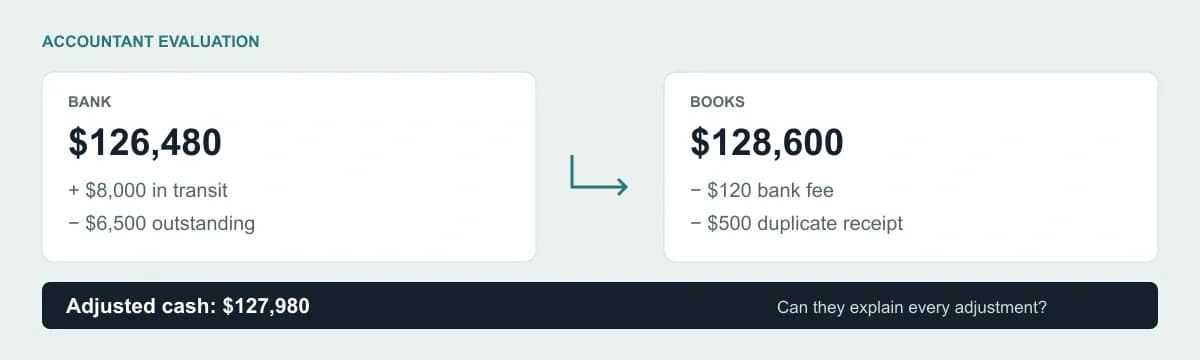
The adjusted cash balance is $127,980. The deposit and outstanding check adjust the bank side of the reconciliation. The missing fee and duplicate receipt require proposed book corrections.
| Reconciliation | Bank side | Book side |
|---|---|---|
| Starting balance | $126,480 | $128,600 |
| Deposit in transit | + $8,000 | Already recorded |
| Outstanding check | − $6,500 | Already recorded |
| Unrecorded bank fee | Already reflected | − $120 |
| Reverse duplicate receipt | Only one receipt at bank | − $500 |
| Adjusted balance | $127,980 | $127,980 |
Swipe horizontally to see all columns.
Proposed entries: debit Bank Fees Expense $120 and credit Cash $120; debit Accounts Receivable $500 and credit Cash $500 to reverse the duplicate receipt. The timing items do not require another entry because they are already correctly recorded in the ledger.
A useful handover says what was prepared, what still requires approval and where the evidence sits. For example:
September cash reconciles to $127,980 after two proposed book corrections. The $8,000 deposit and $6,500 check cleared in October. Please review the $120 fee entry and the $500 reversal of R104; supporting records are referenced in the workpaper. Both entries remain unposted pending approval.
Then change the evidence: replace the verified R104 facts with two same-amount ledger entries and no supporting bank detail or remittance. The duplicate is now only suspected. A stronger candidate keeps the $500 unresolved, identifies the evidence needed and explains the next action. They do not book a reversal merely to make the reconciliation balance.
Make the follow-up reveal the level
For a staff role
“Show me which source supports each adjustment.” Look for correct classification, a usable workpaper and appropriate escalation of the unresolved item.
For a senior role
“A preparer booked the $500 to miscellaneous expense to force a match. How would you review it?” Look for investigation of the receipt and related receivable, correction through the approval process, and a proportionate control improvement.
For both
“What would you hand over if you had to stop now?” Look for an honest status, supporting records, outstanding questions and a named next action. Do not confuse confidence with completeness.
Record whether the candidate found an issue independently, after a prompt or only after being shown the answer. A corrected result is useful evidence, but it tells you something different from an independently completed assignment.
Use an evidence rubric, not a gut-feel score
For each dimension, record demonstrated, needs follow-up, material concern or not observed, plus the evidence. Define must-haves before interviews. Do not turn missing evidence into a zero or let a total score conceal a serious accounting or control issue.
| Dimension | Evidence to record | Reason to follow up |
|---|---|---|
| Accuracy | Correct balance and entries; independent checks are visible. | Unexplained plug, incorrect debit/credit or untested formula. |
| Source discipline | Each adjustment traces to a supplied record. | Unsupported assumption is presented as a confirmed fact. |
| Judgment | Timing differences, errors and unresolved items are separated. | An entry is proposed solely to force agreement. |
| Review readiness | Workpaper is organised and another person can reproduce the result. | Final number is given without the calculation or support. |
| Communication | Status, uncertainty and requested action are understandable. | A long explanation leaves the reviewer unable to identify the issue. |
| Response to feedback | Candidate tests the challenge and updates the work with a reason. | Accepts every suggestion without checking, or changes numbers without an explanation. |
Swipe horizontally to see all columns.
For this sample, a candidate who reaches $127,980 but cannot explain the $500 reversal has not demonstrated the same understanding as one who supports each entry. Equally, a minor spreadsheet formatting issue should not outweigh sound accounting and a clear handover. Have reviewers record their observations before comparing views, and use the exercise alongside the interview and relevant experience.
Test remote collaboration in the same exercise
Ask for a written handover
Request a concise update containing completed work, open items and the action needed from the reviewer. Evaluate whether a colleague could pick it up without another meeting.
Discuss one live challenge
Ask the candidate to explain an adjustment and respond to a changed fact. Assess communication against the role: an internal preparation role and a client-facing senior role need different levels of presentation.
Agree the working arrangement separately
Confirm overlap for questions, close deadlines and meetings. Set a weekly one-to-one and relevant team or project meetings. Do not infer working hours from where someone lives.
AICPA & CIMA describes readiness as combining technical accounting knowledge with business context, communication and judgment in using technology. The small handover above lets you observe those qualities in the work itself. Source: AICPA & CIMA, Building a profession-ready CPA workforce.
If spreadsheets, online references or AI tools are allowed, say so up front and apply the same rule to everyone. Ask candidates to explain and check the output they submit. Use synthetic or properly redacted data, and keep client information out of the exercise.
Turn the assessment into a hiring decision
Match the evidence to the job
List the responsibilities demonstrated, the gaps still open and the review support the person would need. If the role needs inventory accounting, a cash exercise does not establish that capability.
Resolve material gaps
Use a focused follow-up for a missing requirement. Distinguish a trainable company-specific process from a skill the person must bring on day one.
Agree the first assignment
Name the inputs, expected output, reviewer and decision rights. Build this into the 30–60–90-day onboarding plan.
Nexteam connects companies with remote finance and accounting professionals. Our vetting process covers relevant experience, technical assessment, practical work and communication. Discuss the evidence available for the candidates proposed for your role, then use your interview to test the match to your business.
Questions buyers ask
How do I assess a remote accountant before hiring?
Define the responsibilities, examine comparable experience and use a short work sample. Review both the result and the reasoning. Confirm communication, capacity, availability and working hours as separate requirements.
Should staff and senior accountants take the same test?
They can share a core exercise, but the follow-up should match the job. Staff preparation and senior review require different evidence. Add relevant technical work where the role includes responsibilities the shared exercise does not cover.
Does a qualification replace a practical assessment?
A relevant qualification is part of the evidence. It does not show how someone will handle your source data, systems and review process. Verify any credential required for the role separately.
Should candidates complete a real client assignment?
Prefer a short, synthetic exercise that reflects the job. Keep its scope clear and avoid asking for usable client deliverables as unpaid assessment work. If a longer paid trial is appropriate, agree its scope and terms first.
Staff accountant hiring
Hiring a staff or senior accountant?
Choose staff or senior level, then tell us the work you need covered. Add your contact details at the final step.