


Agree what a review-ready output contains, inspect the evidence and reasoning, and return feedback the person can act on. A remote finance professional should work to the standards your team applies to the same role on-site.
The handoff needs enough context for a reviewer to understand the work without reconstructing it through a string of messages. That becomes especially useful when preparation and review happen at different times.
Define what arrives for review
Before work starts, agree the output, relevant checks, reviewer and delivery checkpoint. An example of an accepted prior output helps make those expectations concrete.
| With the output, ask for… | What it helps the reviewer understand |
|---|---|
| Source references and reporting period | Which inputs support the work and whether they cover the intended scope. |
| Checks performed | How the preparer checked completeness, consistency and calculations where relevant. |
| Assumptions and judgments | Where interpretation was needed and what informed the proposed treatment or conclusion. |
| Open items and changes | What remains unresolved and what changed since the earlier version. |
Keep the evidence proportionate to the assignment and use the team's existing systems. An experienced person completing familiar work may need a different level of discussion from someone learning a new process.
Separate a correction from a decision
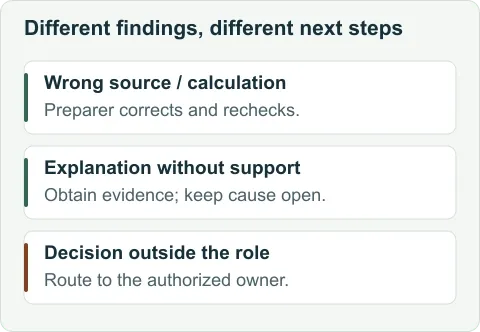
Fictional example: a financial analyst submits part of a monthly reporting pack. Three issues emerge during review.
| Review finding | Useful next action |
|---|---|
| The commentary uses an earlier version of the budget. | Ask the analyst to update the comparison, identify affected sections and repeat the relevant checks. |
| A margin movement is attributed to pricing, but the supporting business information is missing. | Ask for the evidence behind the explanation; keep the cause open until it is supported. |
| An allocation question requires a decision outside the analyst's authority. | Route the decision to its owner and agree what can be completed while it remains open. |
A correction belongs with the person who can fix it. A business decision belongs with the person authorized to make it. Preserve that distinction in the review comments so neither item disappears into a general “please revise” message.
Give feedback that explains the issue
Use a specific location, explain what needs attention and state what the next version should resolve.
| Vague comment | Actionable feedback |
|---|---|
| “Check the numbers.” | “The summary and supporting schedule use different budget versions. Align them to the agreed source and identify which variances changed.” |
| “Explain this better.” | “The commentary names pricing as the cause. Add the supporting analysis or identify the cause as an open question.” |
Let the professional explain their reasoning and propose the revision. Agree who owns it and when it will return. For a complex issue, a short screen-share can help both people reach the same understanding; capture the decision in the work record afterward.
Toptal's remote-work playbook emphasizes specific, ongoing feedback and follow-up actions. The reporting example here is an illustration of how that principle could be applied in finance.
Close the review loop
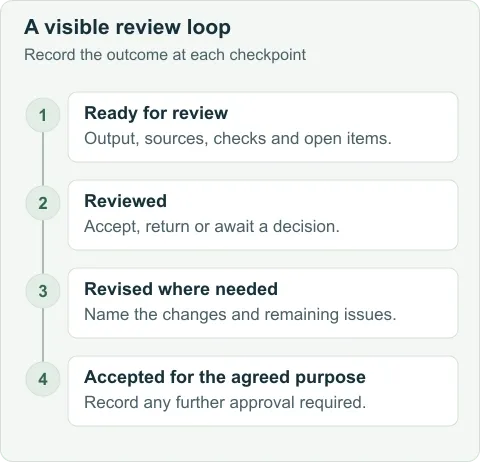
Use statuses that describe what actually happened: ready for review, returned for revision, waiting for a decision, or accepted for the agreed purpose. Receiving a file does not itself establish that review is complete.
The professional incorporates feedback and identifies what changed. The reviewer checks the revision at the agreed level and records any remaining issue or approval required by the process.
If the same problem returns, look at the cause with the person. They may need a clearer example, stronger source control, more context or additional practice. Repeated comments without a change in the working process are unlikely to resolve a recurring misunderstanding.
Use the review to develop ownership
As the person demonstrates understanding across complete cycles, adjust the support and review approach to the work's complexity and the company's controls. Ask them to explain exceptions, anticipate questions and maintain the process notes.
Bring the output you need, an example of the expected standard and the reviewer into the role discussion. Together they make it clearer what experience the professional needs and how they will work with your team.
Related: Financial analyst interview scorecard · Remote financial controllers · Talent solutions.