


Your analysts are producing the models and research. Yet the deal lead still rewrites the conclusions, coordinates every dependency and turns separate files into something ready for the client.
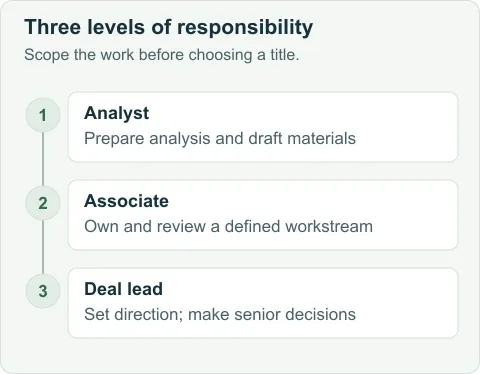
An additional analyst may increase output. An M&A associate may be the better fit when the missing capacity is ownership of a defined part of the transaction: planning the work, reviewing inputs, coordinating people and escalating the decisions that need senior judgment.
Titles differ between firms. Use the responsibilities below as a hiring framework, rather than assuming every associate or VP has the same remit.
Locate the bottleneck before choosing the title
| Where work slows down | Capacity to consider |
|---|---|
| Specified analysis is waiting to be built. | Analyst: research, models and materials within an agreed brief. |
| Output needs repeated coordination and review. | Associate: a defined workstream from planning through reviewed output. |
| Process leadership and difficult client decisions remain unowned. | Experienced associate, VP or deal lead: scope execution leadership and client authority explicitly. |
| The team is chasing files and organizing requests. | Transaction coordinator: document tracking, version control and follow-up. |
That last distinction matters. Do not buy a more senior investment-banking title simply to organize a data room. We cover that situation in When Your M&A Analyst Is Chasing Documents.
Define what the associate owns
An associate should still be comfortable with the analysis. The value comes from connecting it to the transaction, reviewing it and getting it ready for the next decision.
| Workstream | Analyst contribution → associate ownership |
|---|---|
| Financial model | Analyst: build schedules and cases. Associate: define the brief, review assumptions and explain what changes the conclusion. |
| Buyer or target research | Analyst: research and source the data. Associate: set criteria, review the shortlist and resolve inconsistent classifications. |
| Transaction materials | Analyst: draft pages and exhibits. Associate: connect the narrative, check consistency and prepare a reviewable version. |
| Diligence | Analyst: organize requests and responses. Associate: prioritize issues, connect findings to analysis and escalate gaps. |
| Client updates | Analyst: prepare supporting detail. Associate: deliver the agreed workstream update and clarify next actions. |
The deal lead retains the decisions and relationships assigned to them. Scope client contact, valuation recommendations, negotiation and external communications explicitly; do not treat a senior title as unrestricted authority.
This distinction is consistent with the mix of work in published bank role descriptions. For example, Bank of America's associate description combines analysis and transaction materials with client meetings and mentoring analysts. That is useful context, not a universal definition for every boutique firm. Bank of America: Investment Banking Associate
A practical example: the first management presentation
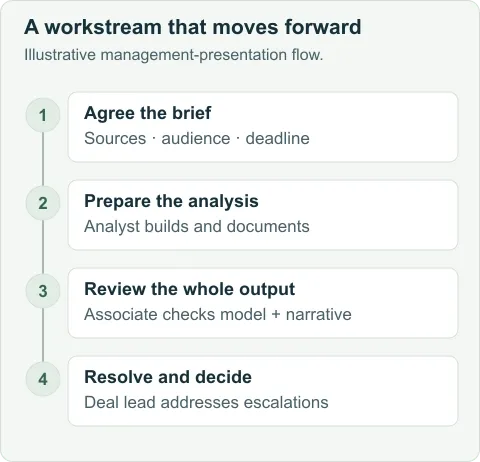
Consider an illustrative sell-side engagement. The analyst updates historical financials and prepares initial exhibits. Three versions of the revenue file arrive, the latest customer schedule does not reconcile, and the client meeting is approaching.
An associate who owns this workstream would:
- Confirm the current source files and document unresolved differences.
- Agree what the presentation needs to establish and assign the remaining analysis.
- Review the model, exhibits and narrative together.
- Separate supported findings from questions that need management input.
- Give the deal lead a concise review pack: changes, open points and required decisions.
The associate should not quietly select the most convenient revenue number or present an unverified explanation as fact. A good handover makes the uncertainty easier to see and resolve.
Interview for ownership, not just exposure
Ask for one transaction example and stay with it. “I supported diligence” is a starting point, not evidence of what the person can own.
| Ask | Listen for |
|---|---|
| “Which deliverable were you personally responsible for?” | A specific scope, deadline and reviewer. |
| “What did you change after reviewing the analyst's work?” | A concrete analytical or presentation issue, and why it mattered. |
| “What did you escalate rather than decide yourself?” | Awareness of authority, uncertainty and client sensitivity. |
| “How did the work reach the next person?” | An organized handover, clear open points and usable source files. |
A short exercise can include an anonymized draft model or presentation with a few inconsistent inputs. Ask the candidate to prioritize what to resolve, explain what they can conclude and draft the update to the deal lead. Use fictional or appropriately anonymized material; you do not need a live client file to test judgment.
Integrate the associate into the deal team
A remote associate works best as a normal member of the team: included in project meetings, connected to the analysts and given the context behind the assignment.
Agree one initial workstream, its outputs and review checkpoints. Define who can contact the client, what needs partner approval and which hours require live overlap. Expand ownership after reviewing completed work and how the person handles exceptions.
For a role involving regular client meetings and live transaction coordination, time-zone overlap needs to support those commitments. A preparation-heavy assignment may allow more asynchronous work. Use the actual meeting and review schedule to set the requirement; see our time-zone overlap guide.
Hiring for your M&A team?
Tell us where work is getting stuck, which deliverables the new person should own and how much client contact the role involves. We can help you scope analyst, associate or more senior execution support.

Prefer to start in writing? Email your role outline.
Explore investment banking talent and our guide to moving from a task to workstream ownership.