
Practical guide
Outsourced FP&A: Who Owns the Forecast After Handover?
A model is only the beginning. Define who updates the forecast, challenges assumptions and carries the work into the next business decision.

FP&A analyst hiring
Give the next forecast a clear owner
Describe the planning cycle, business decisions and capacity you need. We’ll discuss the analyst experience that fits your team.
The next forecast is the real test
The model has been delivered. A week later, sales moves a contract into next quarter, operations changes a hiring date and the CFO wants to know whether the business can still fund the expansion.
Who updates the assumptions, speaks to those teams, checks the consequences and brings a supported answer? That is the buying question behind outsourced FP&A. A model handover can finish a project. A recurring finance role needs someone to carry the work through the next decision and the next cycle.
Which gap are you trying to fill?
Build something defined
A model, scenario analysis or reporting redesign has a clear end point. Specify the output, review rounds and who maintains it after handover.
Run an agreed service
A provider manages a recurring planning or reporting process. Confirm its delivery lead, input dependencies, review arrangements and change process.
Add a colleague to the cycle
An analyst works directly with your finance lead and business teams. Your manager sets priorities; the analyst develops recurring ownership of the analysis.
“Outsourced” can describe all three. “Nearshore,” “offshore” and “freelance” do not settle which arrangement you are buying. Ask who directs the person, who deals with missing information and what happens when priorities change.
AFP describes FP&A around planning and forecasting, performance management and financial analysis in support of business decisions. That is a broader responsibility than refreshing a presentation. The practical division of work below is a starting point to adapt to your company.
Choose the arrangement around the decision
| You need… | A suitable starting brief | Settle before starting |
|---|---|---|
| A model for a financing or acquisition decision | Defined specialist assignment with assumptions, scenarios and handover | Who will operate it after the project? |
| A recurring pack delivered to an agreed scope | Provider-managed process with a named delivery lead | Who gathers inputs, investigates variances and handles changes? |
| Ongoing support across forecast and business discussions | An embedded FP&A analyst with a manager and access to business owners | What can the analyst own, and which decisions remain with leadership? |
Swipe horizontally to see all columns.
Make the ownership visible
The analyst can own the model’s maintenance, the forecast timetable, analysis and follow-through. Business owners remain responsible for explaining operational assumptions. Accounting supplies the agreed actuals. The CFO or another authorized leader accepts the forecast and makes the business decisions.
An analyst should challenge an assumption that does not fit the evidence. That does not give the analyst authority to commit the company to a hiring plan or change a sales target without the right approval.
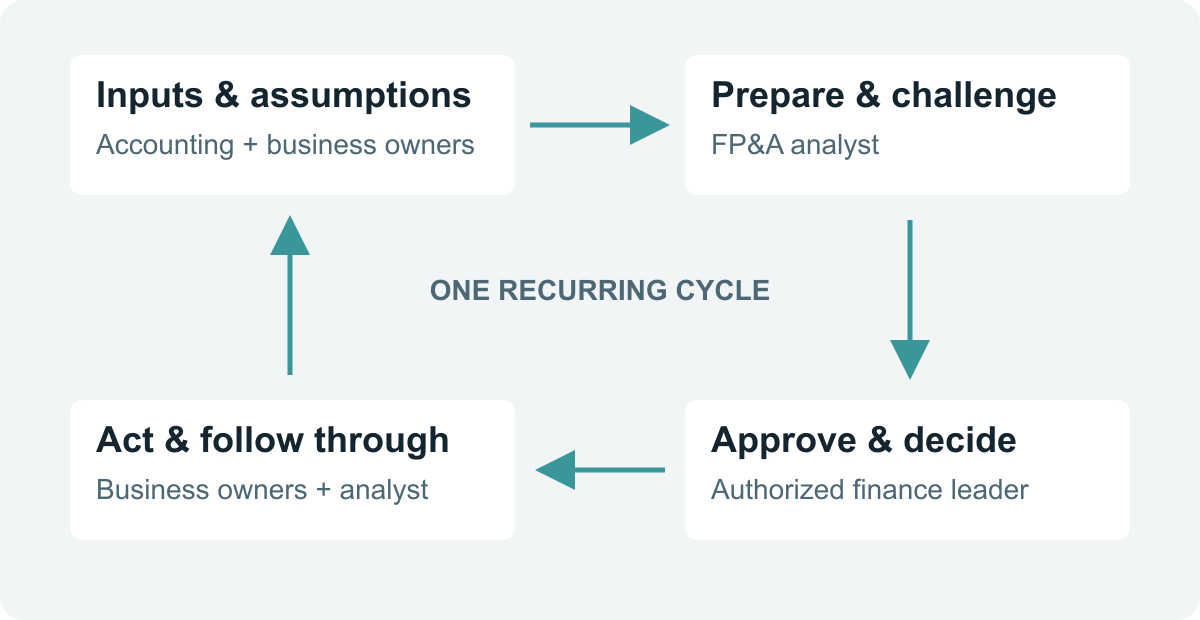
Who owns what in the recurring cycle?
| Work | Responsible for preparation or coordination | Review or decision |
|---|---|---|
| Actuals and accounting changes | Accounting lead releases the agreed version and flags adjustments | Controller confirms accounting treatment |
| Revenue, hiring and operating drivers | Business owners supply evidence; analyst checks completeness | Relevant business lead confirms assumptions |
| Model update and version control | Analyst updates, reconciles, runs checks and records changes | Finance reviewer tests the work |
| Variance analysis and scenarios | Analyst explains movements and raises unresolved questions | CFO challenges implications and priorities |
| Forecast approval and actions | Analyst records the approved version and action list | Authorized leaders approve assumptions and decisions |
| Next-cycle follow-through | Analyst tracks open items and coordinates updates | Manager resolves competing priorities |
Swipe horizontally to see all columns.
A monthly cycle that survives a missing input
Agree the decision before refreshing the pack
Write the questions this forecast must answer. For example: can the planned hiring proceed if a customer starts a month late? Set the review date and work backward to input deadlines.
Establish which actuals are safe to use
Confirm the ledger version, mapping and known adjustments with accounting. Mark provisional figures clearly. A late close should not silently become an unexplained forecast revision.
Ask business owners for drivers, not unexplained totals
Capture what changed, the supporting evidence and who owns the assumption. Record dependencies such as signed contracts, capacity or recruitment timing.
Show the movement from the previous forecast
Separate updated actuals, changed business assumptions and model corrections. Give the reviewer a bridge and a short list of unresolved decisions.
Challenge, approve and carry forward
Discuss sensitive assumptions with the relevant people. Save the approved version and assign actions. Bring unresolved items into the next cycle instead of losing them in the meeting notes.
When sales misses the input deadline
Suppose a material contract has no confirmed start date. The analyst should not silently copy last month’s assumption or substitute a guess and call it the base case.
A useful response is to document the last approved assumption, ask the sales owner for evidence, show the effect of a delay and escalate the unresolved decision before the review. Leadership can then approve a temporary assumption, request a scenario or defer a decision. The analyst records that choice and its owner.
This is where working-hour overlap can matter: resolving a judgment call in the same working day may be more valuable than having an extra hour of spreadsheet capacity. Match overlap requirements to business discussions and decision deadlines, rather than imposing the same schedule on every finance role.
Take the worksheet into your next discussion
Monthly FP&A ownership planner
Assign names to ten stages, set relative working-day targets, record acceptance evidence and track what is still blocked. A task marked ready for review is kept distinct from an accepted task.
Three ways an FP&A hire can miss the real problem
The data has no owner
An analyst can reconcile and improve the process, but cannot manufacture reliable source information. Name the accounting and operational input owners before promising better forecasts.
Nobody can make the decision
More scenarios will not resolve a business choice that leadership keeps deferring. Give the analyst an escalation route and the CFO a clear decision list.
The role contains every finance backlog
Close cleanup, transaction support and continuous forecasting may exceed one person’s capacity or expertise. Separate recurring duties from projects and agree what can move.
Write a brief for the cycle, not a list of software
A useful FP&A brief describes the business decisions and the work surrounding them:
Own preparation of our monthly revenue and operating-expense forecast, including actuals checks, driver updates, variance analysis and follow-up with business owners. Our finance lead sets priorities and approves the forecast. The first assignment is one complete business-unit forecast with documented assumptions and a comparison to the prior version. Broader ownership follows after we review that cycle together.
Add the systems, business model, reporting audience, expected capacity and meeting windows. Identify whether the person needs to explain results directly to business leaders. Test that ability with a realistic discussion of assumptions, not only an Excel exercise.
Use the financial analyst interview scorecard to examine analytical work and communication. The first 30–60–90 days guide helps turn the agreed role into a staged handover.
Where Nexteam fits
Nexteam helps you find a remote financial analyst who can work as part of your team. In that arrangement, your manager directs the work; the professional joins the relevant systems, meetings and working relationships.
Start with the cycle you need covered, the business discussions involved and the reviewer’s expectations. We can discuss the experience and capacity to look for. If you need an external provider to manage an entire FP&A service, define that separately rather than assuming it comes with an analyst hire.
Before you outsource FP&A
Can a part-time analyst own a recurring forecast?
Potentially, if the agreed capacity covers the cycle, business discussions and peak periods. Agree reserved availability and what happens when an urgent decision overlaps with another commitment.
What should remain with the CFO?
Business priorities, authorized approval of assumptions and the resulting decisions. An analyst can prepare, challenge and coordinate the work, while escalating questions outside their authority.
What should be handed over at the end of a project?
The working model, identified inputs, assumption history, checks, update instructions, access arrangements and open questions. Name the person responsible for the next update before the project ends.
FP&A analyst hiring
Give the next forecast a clear owner
Describe the planning cycle, business decisions and capacity you need. We’ll discuss the analyst experience that fits your team.