
Practical guide
QuickBooks to NetSuite: Who Owns Finance During the Move?
Keep the close running during your ERP transition. Define the accountant, controller and implementation responsibilities before adding support.

Accounting and controller support during ERP transition
Need finance capacity while your system changes?
Tell us what must keep running, your systems and who will review the work. We will help define the accounting or controller role.
Protect finance capacity during the move
The NetSuite project is moving. Your controller is in mapping workshops, answering configuration questions and reviewing test results. Meanwhile, suppliers still need paying, customer receipts need applying and the month still needs closing.
The missing line in an ERP project plan is often who keeps the finance function running while the existing team helps build its replacement.
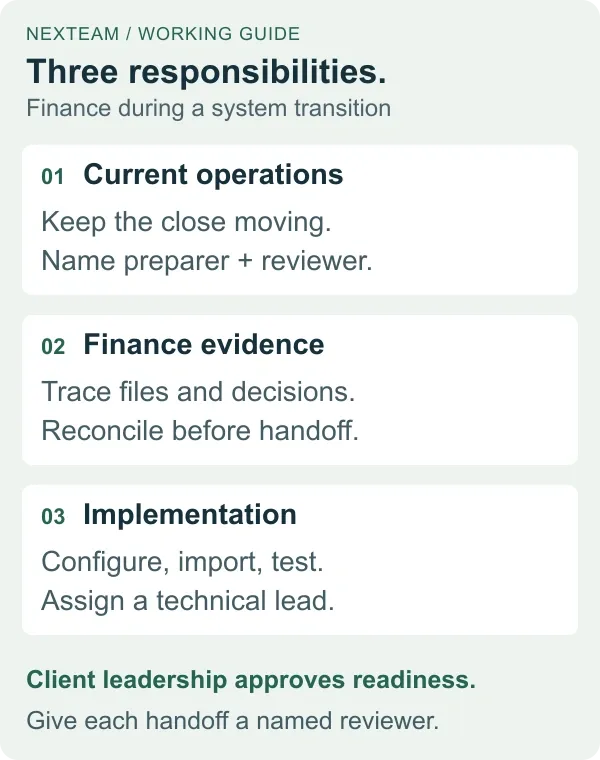
Before hiring a “NetSuite accountant,” separate the work into three responsibilities: maintaining current operations, preparing finance evidence for the migration, and configuring the new system. They need coordinated owners, but they are different assignments.
Three questions before you hire
What must continue?
Name the close, payment and reporting commitments that cannot pause during the implementation.
What needs finance judgment?
Separate preparation from mapping decisions, exception treatment and acceptance.
What belongs to implementation?
Keep configuration and technical migration with the owner contracted to deliver them.
Protect the close before adding project work
Start with the next reporting deadline. List the reconciliations, payroll inputs, supplier runs, collections follow-ups and management reports that must continue during the transition. Name a preparer, a reviewer and a backup contact for each.
Then compare those commitments with the implementation calendar. A controller cannot review the close and participate in a full day of workshops at the same time. If both appear on the plan, someone must move a deadline, reduce scope or provide additional capacity.
A practical support brief might read:
Maintain the existing close schedules and investigate assigned reconciliation differences while the controller leads finance decisions for the ERP project. Escalate unresolved items with supporting evidence; the controller retains review and approval.
That brief describes work a candidate can demonstrate. “Help with the migration” leaves the responsibilities open to interpretation.
Separate ownership across four workstreams
Use this starting allocation to discuss your implementation agreement and the team's capacity. Name a preparer and a reviewer for each handoff.
| Work | Owner and accepted handoff |
|---|---|
| Keep finance running | Accountant or transactional specialist prepares reconciliations, payment schedules and exceptions; the finance reviewer accepts them. |
| Prepare migration evidence | Designated finance lead owns mapping decisions, source cutoffs and reconciliations. Preparation can be delegated. |
| Configure and import | Implementation lead owns agreed configuration, technical imports and technical issue resolution. Finance checks business results. |
| Accept readiness | Client finance leadership records unresolved issues, their treatment and readiness decisions. |
A controller may own finance migration evidence while an implementation partner performs imports. Put that boundary in writing before increasing either person's workload.
For a broader staffing decision, see building a finance team after an acquisition.
Build a traceable evidence pack
An export is useful only if the next person knows what it represents. Record the legal entity, source system, reporting basis, currency, period, extraction time and included filters. Keep the original export separate from the working file and retain a log of approved changes.
For QuickBooks Online, Intuit documents exports for reports and lists, with separate instructions for items such as attachments and purchase orders. That is a starting point for identifying available source material, not a complete migration specification. The exact scope depends on your QuickBooks product and your implementation plan. See Intuit's export guidance.
A useful finance evidence pack includes:
- Source baseline: agreed reports and supporting schedules at a stated cutoff, including open items where relevant.
- Mapping decisions: source account or record, destination, reason, decision owner and unresolved questions.
- Reconciliation evidence: what was compared, the difference, its explanation and the person who reviewed it.
- Change log: what changed after the baseline was agreed and whether the affected checks were repeated.
Do not treat a completed chart-of-accounts import as proof that balances are ready. Oracle's CSV Import FAQ distinguishes account setup from importing account balances. Agree the balance and open-transaction approach with your implementation lead; avoid loading overlapping information twice.
Test one handoff before expanding the assignment
Consider this example:
The receivables ledger agrees to the trial balance. During migration preparation, the accountant finds an unapplied receipt and a credit note recorded after the agreed cutoff. The import file now differs from the version previously reviewed.
The useful response is a short exception note: the affected records, the two cutoff dates, the resulting difference, and the decision needed from the controller. Once the treatment is agreed, the preparer updates the controlled file and the reviewer repeats the affected checks.
Simply overwriting the export would hide the reason for the difference. Simply reporting “the totals do not match” would leave the controller to reconstruct the work.
Use a sanitized version of this situation in an interview. Ask candidates to explain their checks and escalation, rather than rewarding speed or an unexplained balancing adjustment.
Hire for the bottleneck
| Where work is getting stuck | Role to investigate |
|---|---|
| Reconciliations and close schedules are late; a controller can review | An accountant or senior accountant with demonstrated close and reconciliation experience. |
| Supplier runs or receipt application fall behind | AP or AR preparation capacity, with payment and credit authority explicitly assigned. |
| Nobody can resolve accounting questions or coordinate review | Controller capacity with an agreed decision remit. |
| Configuration, integrations or import mechanics are the problem | An implementation specialist. System use on a CV does not establish implementation expertise. |
Ask candidates what they personally prepared, reviewed and approved in a previous transition. Use a relevant accountant work sample, then confirm senior accountant or controller experience against your assignment.
The temporary role should have a first output, a review slot and a handback point. For example: own the existing bank and receivables schedules for the next close while the controller reviews migration decisions. Expand the work after that first handoff is reliable.
Agree the handback before the start
Agree how current operations will be handed back, who accepts the first close in the new system, where unresolved items remain visible and how the engagement ends or changes after stabilization. Keep access and payment authority aligned with the client's control procedures throughout.
Use the Finance Transition Ownership Brief to record the immediate workload, reviewer, evidence and escalation route before writing the role description.
Before ending the assignment, confirm who owns the first close in the new system, where outstanding exceptions are recorded, and who accepts the handover. Nexteam helps you recruit finance capacity that integrates into your team; your leadership manages the work and retains approval authority.
Accounting and controller support during ERP transition
Need finance capacity while your system changes?
Tell us what must keep running, your systems and who will review the work. We will help define the accounting or controller role.