
Practical guide
Choosing a Nearshore Accounting Partner
10 questions to compare the people, review, costs and continuity behind the proposal—before you commit.
Senior accountant hiring
Looking for an accountant who joins your team?
Tell us the role, responsibilities and working hours you need. Leave your email at the final step.
Start with the work your team needs covered
Three proposals arrive. Each promises a dedicated accountant, strong English and experience with your software. One supplies a person you manage. Another includes a supervisor who reviews the work. The third recruits someone your business will employ.
The prices are easy to compare. The responsibilities take a little more work.
To choose a nearshore accounting partner, compare providers against the same work brief, confirm who manages and reviews the work, and ask for evidence behind the promises. Then assess the individual who will join your team.
A useful starting question: “If a reconciliation still has an unexplained difference on close day, who investigates, who reviews the correction and who tells us the deadline is at risk?” The answer reveals more about the operating model than “full-service accounting support.”
The work
Specify the recurring responsibilities, systems, deadlines and exceptions the person must handle.
The people
Identify the accountant, the day-to-day manager and the reviewer. Establish which roles each proposal actually includes.
The evidence
Use a relevant work walkthrough, a written scope and clear commercial terms to test the fit.
The model and the people
1. What exactly are we buying?
“Nearshore” describes geography relative to your business. It does not establish who employs the professional, directs the work or accepts the output. An accounting staffing partner, a recruiter and a managed accounting provider can all use the term.
Ask the provider to map the responsibilities below to its actual proposal. A provider may offer several models; the package you select is what matters.
| Model | What to establish before comparing prices |
|---|---|
| Recruitment / direct hire | The provider finds candidates. Confirm who employs the person, what the placement fee covers and what support remains after the hire. |
| Embedded professional / staff augmentation | The professional works as part of your team. Identify your manager and reviewer; confirm who handles the engagement, payroll or invoicing and any employment administration. |
| Managed accounting service | The provider takes responsibility for agreed delivery. Specify the outputs, review included, service boundaries and decisions your business retains. |
Swipe horizontally to see all columns.
Nexteam’s hiring model centers on a named professional who integrates into your team. Your manager sets priorities, provides business context and agrees how the work is reviewed. The person can take meaningful ownership of a workstream within that structure.
If your need includes managing the whole accounting function, name that gap before hiring. Our delivery-model comparison explains how the responsibilities differ.
2. Who will actually do the work?
Ask whether you are selecting a named professional, reserving hours from a shared team or purchasing an output. For an embedded hire, meet the person before committing. Confirm the working schedule, allocation to your business, start availability and any process for changing the assigned person.
“Dedicated” needs a practical definition. Does it mean a full-time seat, an agreed part-time schedule or simply a named contact? Can other client work compete with your close deadline? Ask what the provider can confirm now and what is still subject to candidate agreement.
Evidence to request: the proposed person’s profile, an interview and a written capacity commitment. A sample profile demonstrates the kind of talent available; it does not establish who will start.
3. How have you checked the accounting experience?
A software logo on a profile is a starting point. Ask what the person actually did in that system, for which type of business, at what level of complexity and with how much review.
Use one relevant, anonymized task: a reconciliation with an unresolved item, a close schedule with a missing dependency or an accrual that needs supporting evidence. Ask the person to explain the next action and what would require escalation. Keep the exercise bounded and use synthetic or properly anonymized records.
For a senior accountant, look for investigation and resolution of review notes. For a staff accountant, test reliable preparation within an established process. Use our remote accountant assessment guide for the individual evaluation; this article focuses on the partner and engagement around that person.
4. Can the person work with our team in practice?
Agree working hours using your team’s time zone and calendar. Check the overlap needed for close reviews, client calls, urgent questions and meetings, including seasonal clock changes and planned holidays.
Test communication through the work. Ask the candidate to write a short explanation of a reconciliation issue and discuss it with the intended reviewer. Client-facing work may need a different level of live communication from preparation done within a documented workflow.
Evidence to request: a confirmed schedule, a relevant written example and a conversation with the future manager. Use the time-zone overlap guide to define the window around the role.
Delivery, continuity and access
5. Who reviews, corrects and escalates?
Ask the provider to walk through one exception from discovery to resolution. Separate routine preparation, technical review, management approval and communication with the business.
With an embedded accountant, reserve review time inside your team. With a managed service, establish which review is included and which decisions still come back to you. If neither proposal supplies the accounting judgment you need, the missing role may be a controller rather than another preparer.
| When this happens… | Ask the provider to name… |
|---|---|
| A reconciliation does not tie | The investigator, the reviewer and the point at which the issue is escalated. |
| Required evidence arrives late | Who follows up, who reprioritizes the work and who agrees any revised deadline. |
| An entry needs judgment or approval | The person authorized to decide and the evidence retained with that decision. |
| The same review note returns next month | Who corrects the work, updates the process and checks that the change worked. |
Swipe horizontally to see all columns.
The management-capacity test: Who in your business can give the new accountant context, answer questions and review the first close? If that person is already overloaded, include review capacity in the hiring plan.
6. What happens during an absence or departure?
A replacement search and coverage for tomorrow’s payment run solve different problems. Ask about both.
For planned leave, establish the handover, backup owner and tasks that can wait. For an unexpected departure, agree who protects the next deadline while a replacement is found. Find out whether backup capacity is included, separately chargeable or your responsibility.
Evidence to request: the actual continuity arrangement and the replacement terms. If there is no backup accountant, record that honestly and plan coverage inside your business. Shared documentation and system access make a handover possible; someone still needs the capacity and authority to do the work.
7. How will access and financial data be handled?
Have the person responsible for your systems review the proposed setup: individual accounts, multi-factor authentication, device controls, permitted file locations, incident reporting and access removal. Specify which tools may receive financial data, including AI assistants, and who can approve a new tool.
The FTC’s vendor-security guidance recommends assessing suppliers, documenting security expectations and limiting access to what the work requires. Apply that review to the actual arrangement, including subcontractors or other people who may access your records.
If a provider supplies a SOC 2 report, have your security reviewer check the covered systems, locations, reporting period, exceptions and responsibilities assigned to your organization. These are among the checks in the AICPA’s SOC 2 report-review checklist.
Evidence to request: the access plan and relevant security documentation, reviewed against your requirements before access is granted.
Costs and commitments
8. What will the engagement actually cost?
Request a quote for the same responsibilities, hours and comparison period. Keep the provider’s charges separate from the costs and review time your business retains. Candidate compensation alone cannot establish the full cost of a staffing arrangement.
| Cost component | Clarify in each proposal |
|---|---|
| Recurring charge | Currency, billing period, included hours or outputs and how the rate can change. |
| Initial costs | Recruiting, setup, onboarding or other one-time charges, including what triggers payment. |
| Changes and exceptions | Extra hours, new entities, cleanup, software, equipment or coverage; confirm what is included versus separately quoted. |
| Your own capacity | Manager, reviewer and systems-administration time; employment costs where your business is the employer. |
| End of engagement | Notice, minimum commitments and any applicable transfer, termination or handover charges. |
Swipe horizontally to see all columns.
Use the offshore accountant cost guide for budgeting context. For provider selection, use written quotes. Avoid comparing an hourly rate with a monthly managed-service fee until the scope and included capacity line up.
9. How do we evaluate the engagement and resolve a mismatch?
Define what you expect to observe during onboarding: access established, a completed reconciliation, review notes resolved and ownership of agreed recurring work. Set review points that fit the work cycle rather than judging the entire hire from the first few days.
Ask what happens if the fit is wrong. Which circumstances qualify for a replacement? Is there a time limit, additional fee, notice requirement or exclusion? Who covers the work during the search? If a provider offers a trial or evaluation period, establish the payment and cancellation terms in writing.
Evidence to request: an onboarding plan and the applicable terms. A promise to “make it right” leaves too much open to interpretation.
10. Can we leave with our records and responsibilities intact?
Before signing, establish how the relationship can end. Confirm notice, the location and format of working files, access to accounting records, ownership of documentation and who handles open items during the handover.
Distinguish your access to a ledger from control over its subscription or administrator account. A person leaving the engagement should not take the only usable copy of a reconciliation or process with them.
Evidence to request: the exit and handover provisions, plus a practical records-access plan. Our guide to switching accounting providers covers the transition around the next close.
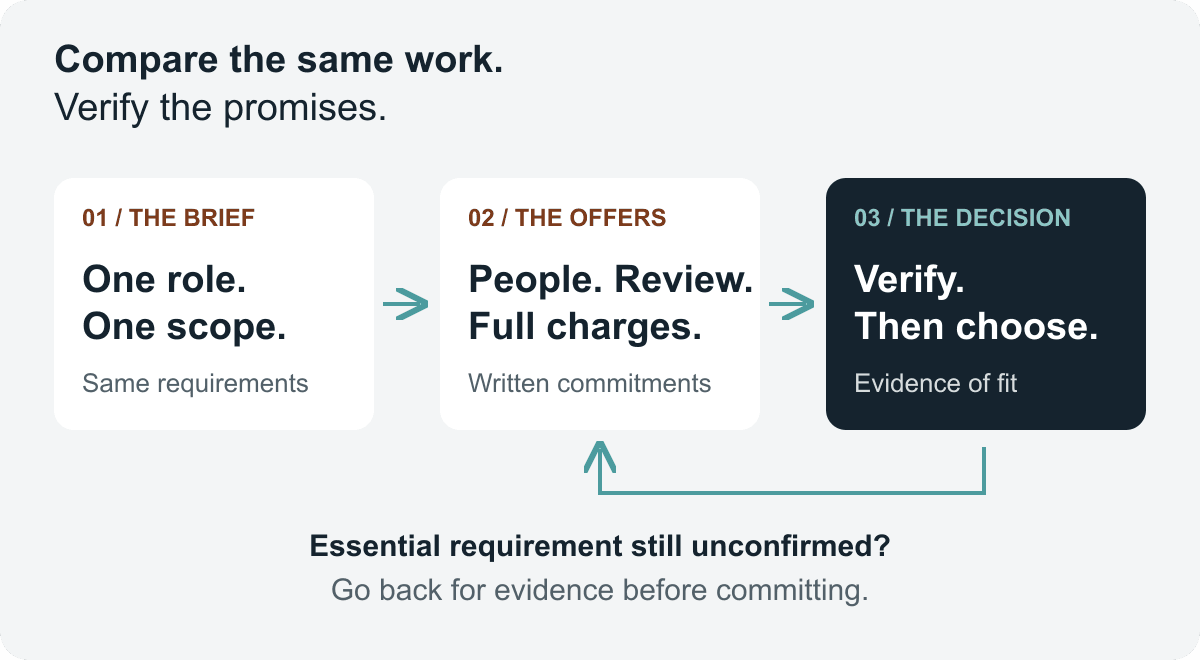
Compare proposals using one work brief
Give each shortlisted partner the same anonymized brief. For example:
“We need a senior accountant to prepare and investigate bank and balance-sheet reconciliations, maintain accrual schedules and resolve review notes. The work covers two entities in QuickBooks Online. Our controller reviews the close. We need an agreed US Eastern overlap window and a first-close onboarding plan. Historical cleanup will be scoped separately.”
Ask every provider to state what it includes, what it assumes you will provide and what remains unconfirmed. The example below shows how apparently similar offers can leave different work with the buyer. These are illustrative proposals, not ratings of actual providers.
| Illustrative proposal | What the buyer still needs to establish |
|---|---|
| A — Named accountant; your controller reviews | Confirm the individual’s fit and capacity. Reserve your controller’s review time. Agree absence coverage. |
| B — Preparation plus provider review | Meet or assess the review lead. Define review scope, response times and approvals retained by your business. |
| C — Recruitment for your own hire | Confirm employment arrangements and ongoing costs. Establish onboarding, management and replacement terms. |
Swipe horizontally to see all columns.
Make the decision in three passes
Set the essential requirements
Choose the few conditions the engagement must satisfy: relevant accounting ability, required working hours, acceptable data access and clear responsibility for review. A competitive price does not resolve a missing essential requirement.
Resolve the unknowns
Record an answer as confirmed, unconfirmed or a gap, with an evidence link and follow-up owner. An unanswered question stays unconfirmed. For an essential requirement, obtain evidence before committing.
Choose among the workable options
Compare the remaining differences in price, management effort, continuity and flexibility. Record why the selected arrangement fits your team and which responsibilities you are accepting.
Download the nearshore accounting partner comparison worksheet (CSV). It includes all ten questions, evidence prompts and space for three providers. Mark each requirement as essential or negotiable before reviewing the offers. Use it to document a decision; there is no automatic score that can make an unsuitable model fit.
Turn the decision into a hiring brief
If you want an accountant who works inside your team, describe the workstream and the support around it. Include the systems, entity complexity, working hours, first deliverable and the person who will manage and review the work.
Nexteam helps you find a professional for that role. Explore accountants in Latin America, then start with the responsibilities you need covered. A defined preparation role, ownership of a difficult close and supervision of an accounting team require different experience.
The aim is a hire your manager can integrate into the team—and an engagement whose responsibilities are understood before the first deadline.
Questions about choosing an accounting partner
What is the best nearshore accounting company for our business?
Start with the delivery model and the work. The right partner for a company with an experienced controller may be different from one for a business needing provider-led review. Compare relevant candidate evidence, ownership, availability, continuity, full charges and exit terms against the same brief.
Is nearshore accounting the same as outsourced accounting?
Nearshore refers to relative location. Outsourcing describes an arrangement for obtaining work or services externally. A nearshore provider may recruit an employee, supply an embedded professional or manage agreed accounting outputs. Confirm the responsibilities in the engagement.
Can we hire one accountant instead of outsourcing the whole function?
Yes, an embedded role can cover defined responsibilities inside your team. Establish the manager, reviewer, authority and working schedule. If nobody can provide review or accounting leadership, include that need in the plan.
Should we choose the lowest-cost provider?
Compare prices only after checking that proposals cover the work and essential requirements. Identify charges and responsibilities that sit outside the headline price. A lower fee can be a sensible choice when the arrangement fits and the retained work is understood.
Senior accountant hiring
Looking for an accountant who joins your team?
Tell us the role, responsibilities and working hours you need. Leave your email at the final step.