
Practical guide
Switching Accounting Providers Without Losing the Month-End Close
A practical handover plan for the records, access and responsibilities your next accountant needs—before the old team steps away.
Senior accountant hiring
Need a new accountant for the next close?
Tell us the systems, responsibilities and handover deadline. Start with the role; leave your email at the final step.
Before changing providers, name the owner of the next close
The replacement accountant starts on Monday. The outgoing provider stops on Friday. The calendar looks tidy—until an invoice arrives late, a bank reconciliation does not tie and both teams assume the other owns the correction.
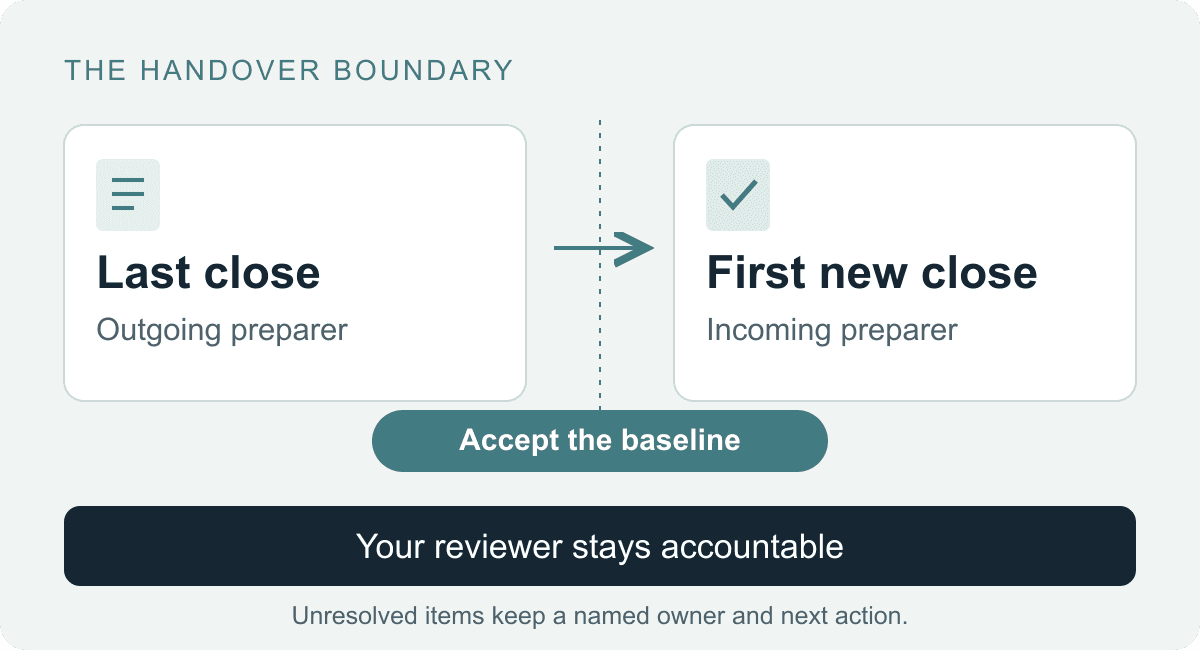
When switching accounting providers, agree who completes the last outgoing close, who accepts the opening position and who owns each workstream after cutover. Confirm system access, evidence and unresolved items before the new team takes over posting.
This matters whether you are moving between outsourced accounting firms, bringing the work into your own team or hiring a remote accountant. A start date establishes availability. A handover establishes what the person can actually take responsibility for.
Three things that must move together
The records
Reconciliations, schedules, transaction support and the status of unresolved items—not just a trial balance.
The authority
Named people who can administer systems, prepare entries, approve payments and release reports.
The responsibility
A clear boundary between the last outgoing period and the first incoming period, including late corrections.
Choose the operating model before the handover
An outsourced accounting provider may manage a defined service and its delivery. An embedded accountant joins your team: your manager sets priorities, supplies context and reviews the work. The transition should reflect the model you are moving to.
If you are bringing accounting in-house, identify the manager and reviewer before hiring the preparer. If you are changing service providers, agree what the incoming provider accepts and what remains with your business. Our delivery-model comparison explains the distinction.
Keep the system stable where practical. Changing the provider, ledger, chart of accounts and reporting format at once adds several sources of differences. If a system migration is necessary, give it a separate owner, reconciliation plan and acceptance decision.
Draw the boundary around a complete accounting period
| Decision | Write it down before cutover |
|---|---|
| Last outgoing close | Entity, period, expected schedules, review deadline and the person who accepts the pack. |
| First incoming close | First period owned by the replacement team, preparation deadlines and the internal reviewer. |
| Transactions around the switch | Who handles invoices received late, cash in transit, unmatched receipts and corrections to the previous period. |
| Posting authority | Who may enter or change transactions in each workstream, and when that authority changes. |
| Unfinished work | A named owner, next action and due date for each unresolved item; keep it separate from accepted work. |
| Transition support | Agreed availability of the outgoing team, the question channel, handover deliverables and any charge. |
Swipe horizontally to see all columns.
Use the engagement terms and actual close calendar to set dates. An abrupt departure may require temporary coverage rather than the sequence you originally wanted. Do not make continuity depend on help the outgoing team has not agreed to provide.
Move through four handover gates
Document the starting position
Identify the latest reviewed period. Record the reconciled balances, outstanding differences, open tasks and reporting commitments. The incoming team can then distinguish inherited issues from new work.
Test the handover
Have the incoming accountant trace one completed reconciliation from source evidence to ledger and review notes. Check that the person can find the records, explain differences and identify the next recurring deadline.
Transfer ownership deliberately
Name the primary preparer for each workstream and its effective handover time. Use overlap for explanation and review. Avoid two teams independently posting the same activity.
Accept the first incoming close
Review reconciliations, corrections, approvals and the final pack. Then resolve the remaining handover items, update documentation and remove access that is no longer needed.
A gate is a decision backed by evidence, not a fixed number of days. You can transfer clean workstreams while holding back one that is not ready, provided the boundary and reporting consequences are explicit.
What the incoming team needs to receive
| Handover area | Evidence and acceptance check |
|---|---|
| Ledger and prior close | Trial balance, general ledger and close pack for the agreed period. Confirm entities, dates, currency and report settings match before investigating differences. |
| Cash and reconciliations | Statements, completed reconciliations, outstanding-item lists and evidence explaining reconciling items. Identify which balances still need investigation. |
| AP, AR and recurring entries | Open-item reports, payment and collection status, accruals, prepayments and recurring-journal schedules. Confirm what has already been processed. |
| Policies and judgments | Current accounting policies, relevant estimates, approvals and known exceptions. Name the person authorized to resolve an unsettled treatment. |
| Systems and records | A system inventory, named administrators, working user access and the location of supporting records. Test that required files open and can be used. |
| Calendar and commitments | Close dates, payroll and payment responsibilities, reporting deadlines and outstanding requests. Assign separate owners for specialist work. |
Swipe horizontally to see all columns.
Treat system control as part of the handover
Being able to log in does not establish who controls the account or pays for it. Check subscription ownership, administrator rights, user permissions, integrations and the location of records separately.
For example, Xero’s subscriber-transfer guidance distinguishes transferring the subscription from changing existing user permissions. In QuickBooks Online, transferring primary admin access has its own eligibility and account-access requirements. Follow the workflow for your product and plan.
Ask your authorized system owner to confirm the transfer is complete. Use individual accounts and suitable permissions; do not make a shared password the handover plan. Preserve the records your business needs before retiring access. Keep the owner and timing of that access review on the same transition list as the accounting work.
A worked example: transfer AP, hold the cash reconciliation
Ready to transfer
The incoming accountant can open the AP ledger, trace the latest payment batch and identify the authorized payment approver. AP preparation can move at the agreed boundary.
Not ready to accept
One operating-bank reconciliation has an unexplained difference. Record the amount, evidence still needed, investigation owner and decision deadline. Do not mark it accepted because the files arrived.
Keep the close controlled
Assign a preparer for the unresolved reconciliation and an internal reviewer. If the outgoing provider cannot continue, secure alternative coverage and adjust the close plan explicitly.
This is an illustrative handover scenario. Readiness can differ by workstream. A blanket “everything transferred” status hides the decision your finance lead still needs to make.
Use a short cutover decision sheet
| Question | Evidence for the decision |
|---|---|
| Can the incoming team work? | Required systems and records are accessible through the intended accounts. |
| Is the starting position understood? | The reviewed baseline is identified; remaining differences are documented and assigned. |
| Does each task have one primary preparer? | Posting boundaries, correction ownership and escalation contacts are written down. |
| Can the business review the output? | A reviewer has reserved time for the first close and can make the required decisions. |
| What happens if a workstream is not ready? | An agreed fallback owner, revised boundary and escalation deadline exist. |
Swipe horizontally to see all columns.
If a critical answer is missing, pause that workstream’s transfer or arrange alternative coverage. If you delay, specify who keeps working, where they post and who reviews. Returning the whole ledger to an earlier state can discard valid new transactions; resolve exceptions through your approved accounting and system procedures.
Download the editable handover checklist (CSV). Add owners, deadlines, evidence links and the acceptance decision. Keep the completed version in your own controlled workspace.
Hire for the work that is missing
A provider change can expose a role-design problem. If your controller has no time to review, adding another preparer may leave the bottleneck intact. If nobody investigates the difficult balances, a task-only brief may recreate the old gap.
Match the hire to the transition
| What is missing | Role to assess |
|---|---|
| Capacity for defined reconciliations, schedules and recurring preparation | Staff accountant, with an established reviewer. |
| Investigation, close coordination and resolution of review notes | Senior accountant with relevant systems and workstream experience. |
| Reporting oversight, accounting decisions and supervision | Controller with a clearly agreed authority boundary. |
Swipe horizontally to see all columns.
Compare our staff accountant, senior accountant and financial controller options against the work you need covered. Nexteam helps you find a named professional who integrates into your team; your business manages the work and retains its approvals.
In the hiring brief, describe the entity and system environment, the next close deadline, the work being inherited, known unresolved items, available working hours and the reviewer. An anonymized description is enough for the initial discussion. Relevant experience and availability need to be confirmed for the individual.
If a finance leader is also leaving, use the controller handover checklist. After the first close, use a 30–60–90-day onboarding plan to expand ownership based on observed work rather than the passage of time.
Questions about switching accounting providers
When should we switch accounting providers?
Choose a boundary around your reporting calendar, handover evidence and agreed support. A period end can make responsibility clearer, but the date alone does not make the transfer ready. Identify who completes the outgoing close and who accepts it.
Can we change providers during month-end?
It may be necessary. Start by protecting the work already underway: name the preparer and reviewer for each task, identify what has been posted and agree how remaining transactions will be handled. Reduce simultaneous changes and secure coverage for unresolved work.
Should both accounting teams work in parallel?
Overlap is useful for explanation, testing and review. Define who is authorized to post in each workstream so the same invoices, payments or journals are not processed independently by both teams.
Does a new accountant need to fix every historical issue first?
Separate recurring delivery from cleanup. Record the inherited issues, assess their effect on the current close and assign owners and priorities. The responsible finance lead must decide which issues prevent acceptance and which can be worked through under an agreed plan.
Can Nexteam take over the entire accounting service?
This hiring model is built around a named professional who works in your systems under your management. Agree responsibilities, seniority, hours and review before starting. A fully managed accounting service is a different delivery model and should be scoped separately.
Senior accountant hiring
Need a new accountant for the next close?
Tell us the systems, responsibilities and handover deadline. Start with the role; leave your email at the final step.